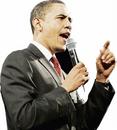
LEFT: Senator Barack Obama
Billy Perking photo
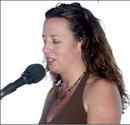
RIGHT: United States religion reporter, Cathleen Falsani, reads excerpts from her book, 'The God Factor', on May 27, 2006, at the Calabash Literary Festival held in St Elizabeth.Mark Dawes, Religion Editor
Long before he was a national figure, United States Senator Barack Obama opened up a window of his soul so that people could understand his religious orientation. He did this in an interview with Chicago-Sun-Times religion reporter, Cathleen Falsani.
That interview, along with 31 others, formed the basis for The God Factor, a volume about the interior lives of public figures, which was published in 2006 by Sarah Crichton Books.
He sat for that interview a few weeks after he had won the March 2004 Democratic Primary in Illinois to become his party's standard bearer for a seat in the United States senate. He was not yet nationally known. But that would change in July when he delivered the keynote address at the Democratic National Convention. Then, to augment his national credentials, he did go on to win the senate seat in November 2004.
Concerning his spirituality, he told the interviewer, "I have a deep faith. I'm rooted in the Christian tradition. I believe that there are many paths to the same place, and that is a belief that there is a higher power, a belief that we are connected as a people, that there are values that transcend race or culture, that move us forward, that there's an obligation for all of us individually, as well as collectively, to take personal responsibility to make those values lived."
What I believe
The now presumptive nominee of the democratic party in the 2008 presidential election disclosed, "I probably spent the first 40 years of my life figuring out what I did believe, and it's not that I have it all completely worked out, but I'm spending a lot of time now trying to apply what I believe and trying to live up to those values."
Falsani observed, that though Obama professes faith in Jesus Christ, he runs counter to evangelical theological tenets by his stated belief that God would not allow someone to go to hell. Yet, "he's not sure if he's going to heaven", Falsani wrote.
According to Obama, "I find it hard to believe that my God would consign four-fifths of the world to hell. I can't imagine that my God would allow some little Hindu kid in India who never interacts with the Christian faith to somehow burn for eternity. That's just not part of my religious makeup."
He told the interviewer, "What I believe in is that if I live my life as well as I can, that I will be rewarded. I don't presume to have knowledge of what happens after I die. But I feel very strongly that whether the reward is in the here and now or in the hereafter, aligning myself to my faith and values is a good thing."
Obama, who professes a "personal relationship with Jesus Christ", admitted not reading his Bible as regularly as he'd like, given the escalating demands on his political life. But, he told Falsani, he does find time to pray.
Conversation with God
"It's not formal, me getting on my knees," rather, he said, "I think I have an ongoing conversation with God. Throughout the day, I'm constantly asking myself questions about what I'm doing and why I am doing it. The biggest challenge, I think, is always maintaining your moral compass. Those are the conversations I'm having with God internally. I'm measuring my actions against that inner voice that, for me at least, is audible, is active. It tells me where I think I'm on track and where I'm off track".
In the book, Obama describes his father as a non-practising Muslim from Kenya and his American mother as 'a lonely witness for secular humanism' who seemed to have been somewhat of a student of the world's religions. She gave young Obama books about the world's religions and talked to him about the values of various faith communities. When he was 10, he lived in Indonesia where he attended a Roman Catholic school in that Muslim nation. He studied the Bible and catechisms day and night within earshot of regular Muslim prayer calls.
Civic religion
Beside his own Christian faith are his convictions about a 'civic religion'. He explained, "I am a big believer in the separation of Church and state. I am a big believer in our constitutional structure. I mean, I am a law professor at the University of Chicago teaching constitutional law. I am a great admirer of our founding charter and its resolve to prevent theocracies from forming and its resolve to prevent disruptive strains of fundamentalism from taking root in this country. I think there is an enormous danger on the part of public figures to rationalise or justify their actions by claiming God's mandate. I don't think it is healthy for public figures to wear religion on their sleeve as a means to insulate themselves from criticism, or avoid dialogue with people who disagree with them."
Born August 4, 1961, Obama spoke about his conversion to the Christian faith by stating that when he got saved, it was the culmination of a process. Furthermore, since his childhood, he said, he has retained a suspicion of dogma and any language that conveys a monopoly on truth.
"I am a big believer in tolerance. I think that religion, at its best, comes with a big dose of doubt. I'm suspicious, too, of too much certainty in the pursuit of understanding. I think that, particularly as somebody who's now in the public realm and is a student of what brings people together and what drives them apart, there's an enormous amount of damage done around the world in the name of religion and certainty," said Obama to the interviewer.
He continued, "The most powerful moments for me come when I feel like my actions are aligned with a certain truth. I can feel it. When I am talking to a group and I'm saying something truthful, I can feel a power that comes out of those statements that is different from when I'm just being glib or clever. I think it's the power of the recognition of God, or the recognition of a larger truth that is being shared between me and the audience. That's something you learn watching ministers - what they call the Holy Spirit.
They want the Holy Spirit to come down while they're preaching, right? Not to try to intellectualise it, but what I see there are moments that happen within a sermon where the minister gets out of his ego and is speaking from a different source. And it's powerful. There are also times when you can see ego getting in the way, where the minister is performing and clearly straining for applause or an amen. And those are distinct moments. But I think those former moments are sacred."
Send feedback to mark.dawes@gleanerjm.com.


















