File
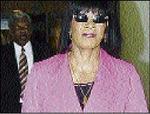
Jamaica's most powerful woman, then former Prime Minister Portia Simpson Miller, is seen in this September 2006 file photo at Jamaica House. Behind her is husband, Errald Miller.
Avia Collinder, Gleaner Writer
The absence of women from the corridors of power has been linked directly to continued disparities in gender income, a newly released report of the Economic Commission for Latin America and the Caribbean (ECLAC) has found.
In the home, it is women who are the bosses, but not in government or corporate offices, in spite of increased levels of tertiary education, saying this is likely containing incomes.
In some cases, the agency also noted declining participation.
Women in Parliament down 13 per cent
In Jamaica, for example, women in Parliament is down to 13 per cent, just above a third of the 30 per cent quota hoped for by ECLAC.
"There is a gender imbalance in the positions of men and women, with more men holding decision-making positions of employers and own account workers," the agency said.
The majority of women remain employees, the report said, "in spite of their overall higher levels of educational participation and attainment."
Jamaica is doing its own study on the gender split among power brokers, due for completion in November.
But reacting to the ECLAC report, local independent consultant and social researcher Carol Watson-Williams, says: "If there is any suggestion that women are being locked out of high-level decision making, then we need to look at why."
Watson-Williams is lead researcher on the two-month study sponsored by the Kingston-based Women's Resource and Outreach Centre and the Canadian InternationalDevelopment Fund to look at the gender balance on local boards and commissions.
The study began in September.
Two academic units at the University of the West Indies - Centre for Gender and Development Studies and the Sir Arthur Lewis Institute for Social and Economic Studies - are collaborators on the research.
Even though women's dominance in the home has been linked largely to the absence of the men, ECLAC says their ability to lead in that sphere is an indicator that they can perform just as well in the board rooms and capitals.
"Caribbean societies are characterised by a heavy presence of single-parent families led by women. The women are, therefore, largely responsible for making decisions in the home," the report said.
"The corollary to that is that they should also be in positions of influence outside of the home because the decisions that are made in the political arena and in the workplace have a direct impact on their circumstances in the household unit."
But, Watson-Williams warns that boosting quotas does not necessarily translate to better decisions and circumstances.
"Women are not magicians and one should not assert that everything would change under their tenure," said Watson-Williams.
"They will be restricted by the economic reality."
The researcher adds, however, that income is linked to levels of involvement in decision making and that both are intertwined.
"Their participation," she said, "feeds the income and the income feeds their participation."
avia.ustanny@gleanerjm.com


















