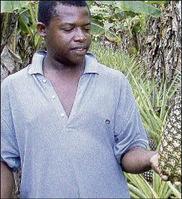
Farmer and vice-president of the St Mary Multi-Purpose Co-operative, Leighton Davis, inspects pineapple on his farm in Fort George, St Mary. - Contributed
'Dropping out of school is not the end of the world," says three-time National Young Champion Farmer, 26-year-old Leighton Davis. "There is life beyond the classroom, if you can find something you are willing to work hard at. We can't all get big jobs in offices with air conditioning."
With this as his personal philosophy, when Davis left school at 17 with only one CXC pass, he decided to join his uncle, Vincent Gardener, in business. Gardener had leased a five-acre plot in Fort George, St Mary.
Today, nine years later, Davis has expanded this operation to a 26-acre farm on land leased from the government. But the path to success was not without challenges and disappointments.
"In the beginning," he recalled, "we planted pineapple and plantain. At that time, we sold to higglers and we were using expensive domestic water. This put food on the table, but there was nothing left after that."
Lost Crop
Then came the first major challenge, the loss of an entire pineapple crop following a spate of flood rains.
But, with guidance and technical advice from the St Mary-based Rural Agricultural Development Authority's (RADA) extension officer, Lenworth Taylor, Davis changed his planting method and began planting the pineapple in contours across the field, using an effective drainage system.
Within about three months, he was back in production.
Ironically, this setback provided the opportunity for him to move his operation to a 10-acre plot of leased land in the same community.
"I worked longer hours and took advice on good farming practices, wherever I could get it."
Good role model
Father Jim Webb, chairman of the St Mary Role Development Project, has nothing but praise for Davis.
"He is my most successful young farmer to have been associated with the project. He has an exemplary attitude to work, and what distinguishes him from many of the other youngsters is that he listens and follows the advice given to him by the technical people," said Webb.
Unlike many of his peers who are sceptical of using gravity irrigation, Father Webb said, "Leighton embraced the technology and with it, the assistance provided by the project to set up a sprinkler system, which allowed him to significantly increase his productivity."
In 2002, Father Webb was in dialogue with the government in a bid to lease land for "serious farmers" to expand their production.
After a long period of negotiations, Leighton secured a 26-acre plot and later, with assistance from RADA's Domestic Food Crop Project, he was able to establish four new acres of plantain.
During this period, he also expanded his production of soursop, naseberry, jackfruit, pineapple and vegetables.
Papaya cultivation
With the encouragement of Byron Henry, RADA's marketing manager and his extension officer, Davis soon diversified into papaya cultivation.
Hurricane and disease
Before the passage of hurricanes Dennis and Emily, which ravaged his fields, Davis had six acres of papaya in production, with a yield of approximately 12 tonnes per acre. While he lost only one papaya field last year during Hurricane Dean, the ill winds blew Papaya Ring Spot Virus his way, and this totally wiped out his production.
Wheel an' come again
A farmer has to have strong faith, he believes, "because you face both natural and man-made disasters. You have to deal with the forces of nature and then there are the thieves."
Determined not to give up, following the onslaught of the Ring Spot Virus, Leighton took the advice of his RADA officers to rest the soil, and is now focusing on his plantain production, which he has inter-cropped with pineapple.
Always open to new ideas and technologies, he established a 5,300-square foot greenhouse last year, with assistance from the St Mary Role Development Project.
"The first trial of tomato was not successful, and I was advised to plant a different variety, and to make adjustments to the watering cycle," said Leighton.
But, he has had better luck with sweet pepper.
"I started with one row, that is about 150, and I am about to reap some 900."
One of the fundamental reasons for Davis' success, says Byron Henry, "is the fact that his production is market-driven, as he sells 90 per cent of his produce to the St Mary Multi-Purpose Co-operative."
This co-operative sells food wholesale to a number of supermarkets and green groceries in Kingston and Ocho Rios, as well as to agro-processors islandwide.


















