
Caribbean classic - Jamaica's unique symphony orchestra showcases talent
Published: Wednesday | November 25, 2009
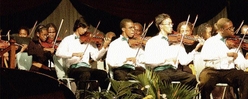
The Jamaica Symphony Orchestra in concert at the Assembly Hall, University of the West Indies, Mona, on Sunday. - Winston Sill/Freelance Photographer
Jamaica's renown as a wonderfully musical nation has come not only because of our prowess in reggae and jazz. We have produced, too, world-class opera singers and classical music instrumentalists.
Now, add to the above a symphony orchestra which surely is one of the world's largest and definitely the only major one with a steel-band section.
Formed in September 2008, the Jamaica Symphony Orchestra (JSO) has more than 100 members and, together with the traditional four sections of a symphony orchestra - the strings, woodwind, brass and percussion - it has a full steel pan unit, which gives it a sound that is both unique and authentically Caribbean. (The steel pan, originating in Trinidad and Tobago, is reputedly the only new musical instrument invented in the 20th century).
On Sunday, the JSO ended its two-venue concert series with a performance in the Assembly Hall at the Mona campus of the University of the West Indies (UWI). The orchestra had played the previous night at Northern Caribbean University (NCU) in Mandeville.
Now, the UWI's Assembly Hall is acoustically quite dreadful and, as a professional musician pointed out to The Gleaner, the only way to counteract its fundamental defects is to have a first-class sound technician install a proper public address system.
Dreadful acoustics
That was not done for Sunday's concert. The intention was to show that the JSO and its two feeder groups, the Jamaica Debut Orchestra (comprising two to five-year-olds) and the Jamaica Youth Symphony Orchestra (six-year-olds to early teens), were active and growing musically.
Happily, the large audience understood this, which is why there was loud applause when one reluctant two-year-old cellist was persuaded to return to the stage to play along with his classmates. Much later, a really fine performance by 20-year-old pianist Mikhail Johnson of Mendelssohn's Capriccio Brillante, Op. 22, was rewarded by a similar grandiose applause.
In terms of the aural pleasure it gave, Johnson's playing was probably the most successful in the two-hour long concert. This is not because he was the best musician there. In fact, there was at least a score who were superior, including many music teachers and more advanced students.
But these others were handicapped, both by having to play on the stage, a virtual echo chamber within the larger echo chamber, that was the Assembly Hall, and by playing along with amateurs. Johnson's piano was on the floor of the hall and its quieter notes did not bounce off walls the way the louder notes of the full orchestra did.
Asked about the programme he was pursuing at NCU, from which he is scheduled to graduate in 2011 with a bachelor's degree in biochemistry and a minor in music, Johnson told The Gleaner that though he had been playing music since he was two years old and had won several prizes in the discipline, music only became his "first love" when he started getting formal training at NCU. Before that, it had been science.
Career in music
Now his plans are for a career in music. "It allows full expression for my emotions," he said. If those plans fail, he would teach science.
Another indication the organisers' intention was to educate and inform the audience, not to entertain with music, was the format of the presentation. Every item, from the tiny one-minute 'finger exercises' by the under-10s to the longer works by adults, was introduced by narrator Ricardo Allicock.
In fact, his explanation of the teaching process and make-up of the orchestra and his biographical details on the musicians was useful - if you were a parent or guardian wanting to see how well little 'Johnny' or 'Jane' was doing.
Most of the audience could only guess from the children's bowing how well they played. Their conductor, Dr Lisa Walker, the American violinist and NCU lecturer who founded the JSO, accompanied the little ones by playing her violin alongside them. Not surprisingly, her instrument completely overpowered theirs.
Impressive sight
The second half was devoted to performances by the JSO. The large stage, filled with 100-plus classical musicians and their instruments, was an impressive sight, one a Reggae Sumfest Dancehall Night could never duplicate.
Pieces by Rossini, Bach, Dvorak and Tchaikovsky were played by the JSO, and nine-year-old violinist Christian Allicock was featured as a soloist in Vivaldi's Concerto in A minor, Mvt. 1, Op 3. Additionally, Jamaican composer David Aarons conducted the orchestra in his own work, Little Dancehall Fugue. The concert ended with the JSO playing an echo-filled version of the Hallejujah Chorus from Handel's Messiah.
The JSO, together with its two orchestras in training, caters to more than 200 musicians and has branches in Kingston and Mandeville. The narrator told the audience that a documentary film on the JSO is being made.
If the enthusiasm of the audience is a good indicator, the concert was a success. One member declared herself an ardent fan of the JSO and stated, "As mi grandchildren born, me going let them start learn music."
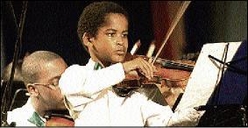
Nine-year-old violinist Christian Allicock. - Winston Sill/Freelance Photographer