
Women who fork - Former banana workers bounce back with European Union help
Published: Saturday | October 24, 2009
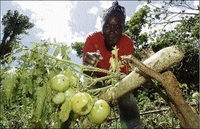
Women farming has become more of a phenomenon over the last decade, as evidenced by this 2008 photo. - File
In most professions, women have been successfully smashing the proverbial glass ceiling for decades. Medicine, law, transport, education, construction, aviation, communication and governance are just a few areas in which women have started to make their mark.
However, when it comes to the physically laborious task of commercial small-scale farming, not so many local women have entered the field as entrepreneurs. Some will engage in a bit of horticulture or backyard gardening, but hard-core farming involving the forking of acres of land with cash crops and other vegetation is another matter.
It is against this background that the Women's Resource and Outreach Centre, in partnership with the European Union (EU) and Christian Aid, has been empowering rural women in St Thomas to develop commercial farms in order to create sustainable livelihood for themselves and their families.
profit-making farming
The project came about following the decline of the local banana industry, from which many women earned their living. Instead of sitting in the unemployment line, some 135 of these women are now actively engaged in profit-making farming activities. Still, this is hard work with many challenges, particularly for women.
At a recent workshop held in Morant Bay, St Thomas, approximately 50 women gathered to discuss some of their toughest challenges. At the top of the list is "preparing the land". "I alone cannot do it, 'cause I am a woman. We need a little help," lamented one female farmer.
"I can use cutlass, but the forking mi cyaah manage so well," she explained. This means that female farmers generally must hire male labourers to assist with forking the land in preparation for planting.
Another farmer noted that in a day-for-day group solution, she worked in groups with other male farmers to lighten the load; they (male farmers) would help to fork her land and she would in turn provide lunch - a sort of barter system.
Still, for most women, there is no getting away from hiring male labourers or doing it themselves. In this regard, 65-year-old Luaska Lawson from Trinity Ville is an inspiration. She complained that "The men dem of today are sucking the ladies' blood, they cannot work for a thousand dollars but they want twelve hundred dollars for the day and then you hear that you are to prepare lunch for them. But as for me and my crew, I rule!" the senior citizen championed.
applause
She added, "If I am giving them $1,000 much more $1,200, no lunch, no cigarette (will be provided). And if they don't work to suit me I don't pay. So when men come to my farm and see what I did, I say 'if you are not working like this don't begin, go home back because I can't feed hungry people like that'," she reasoned to the applause of her female farming companions.
To address this issue of forking or preparing their land, the Creating Sustainable Livelihoods project recently provided labour assistance cheques to female farmers in Mount Vernon, Somerset, Trinity Ville, Spring Bank and Johnson Mountain in St Thomas.
In December 2008, the livelihoods project first engaged community members in committees to identify areas of concern and then later provided tangible benefits such as providing cash crops, chickens and other livestock for farming. The project has also provided dams "and we have completed one check dam across the Fitzgerald Gully", explained Dorothy Whyte, executive director of Women's Resource and Outreach Centre, the implementing agency.
"In addition, we established nurseries so that they can plant seedlings and have them available for sale to the community and others. We have also helped them to build slaughterhouses so that the chickens they get can be slaughtered and sold," added White.
In response to the opportunity to replace and perhaps increase their income from the banana industry, most female farmers are thankful. "I was an ex-banana worker and I wasn't working for a long time and I am an achiever in cash crops, it help me a lot to feed my family to turn my life around," one female farmer shared. Another boasted that "Last year I sow only 2lb of carrot and through this project I am now sowing 4lb, and by the help of God I am going to be a stalwart in this community."
Quite a few of them were also thankful for the opportunity to be independent. "I used to be a domestic helper. I join back the Jamaica Agricultural Society and this cash crop, this project help me to be self-employed and to be independent, not to depend on anyone." A poultry farmer also noted that "This project has helped me a lot, twice I get help from this type of project. I have a daughter in college and is mostly chicken that help me to send her," she stated, beaming with pride.
eu pleased
For his part, Pierre Dawson, monitoring officer with EU local office, is pleased with the outcome of the project so far. He has seen the "project blossom, they have been doing some wonderful work and the impact has been seen when I go into the five communities". He believes the project is helping to level the playing field for women in agriculture.
This success notwithstanding, many challen-ges remain for female farmers: balancing domestic work with farming activities, access to water, landownership and marketing their produce.
However, the women farmers and the livelihoods project team are determined to surmount the odds and keep women positively engaged in the field.
Send feedback to communications@wrocjamaica.org or shellyannharris@gmail.com.