
Strong messages at NDTC's 47th season
Published: Thursday | August 13, 2009
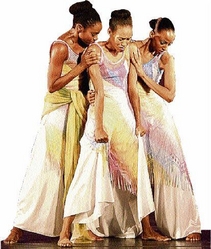
From left, Keita-Marie Chamberlain, Kerry-Ann Henry and Stefanie Belnavis in Kevin Moore's 'Moments of Peace'
"This season is marked by the advent of a feast of new choreographed works offered by a new generation of dance creators." This statement, from artistic director of the National Dance Theatre Company (NDTC), Rex Nettleford, refers to the company's current season of dance at The Little Theatre.
The "feast" metaphor is apt. In all likelihood, only the most persistent fan of Jamaican dance theatre will be able to see all of the season's new works. After three trips to the theatre, The Gleaner had only seen eight of the 12.
Already reviewed are Apocalypse (Nettleford), Caged (Kerry-Ann Henry), Moments of Peace (Kevin Moore) and Vignettes of Life (Clive Thompson), all mounted on opening night July 24. This review focuses on Reflection (Arsenio-Andrade Calderon), My Skin, My Kin (Christina Gonzales), Redemption Rite (Marlon Simms) and Dear Sylvie (Stefanie Belnavis).
Reflection, a solo, opens with the dancer (Chris Walker) in a pool of light at centre stage. He is kneeling with head bowed, his long locks falling down like the roots of a mangrove plant burrowing into the earth. The music, Shaman's Dream by Spirit of the Incas, is haunting, the loudest instruments being a clarinet and background bells.
Perfect body
Walker's perfect dancer's body curls, undulates, writhes and stretches on the floor. It arches, twists, contracts, limbs extend and then he's up. He somersaults, shivers, pushes, claws at the air, remaining centre stage, the darkness outside the light apparently confining him like the bars of a cage. The minutes pass; the distress builds. Then, as the sound of waves attacking the shore grow louder, the dancer's body contracts and resumes its original kneeling position.
The applause from the audience is, of course, enthusiastic. We had just seen a powerful dance. But what did it mean? The Gleaner first asked the dancer.
"It's a reflection on the damage that man has done to the earth, just by being here," said Walker.
Oh? The audience would never have guessed. There are no explanatory notes in the programme. There is no decor to show the setting of the dance.
Walker tries again: "The dancer starts off as an amoeba, evolves into man and then collapses back into what he started from."
So now Walker has given both the theme of the dance and an expla-nation of what we saw. Still, sensing there was something more, The Gleaner tackled the choreographer.
Trip to the jungles
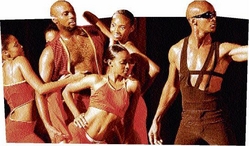
From left, Shaday Gallimore, Kevin Moore (as the Rake), Tovah-Marie Bembridge, Terry-Ann Dennison and Marlon Simms (the Gangster Son) in 'Tintinnabulum' at the opening of the National Dance Theatre Company's 47th season of dance at the Little Theatre on July 24. Photos by Winston Sill/Freelance Photographer
Calderon spoke of a trip to the jungles of Suriname. "It was amazing to see the destruction going on there," he said. "Mother Earth is getting killed by those trying to bring development to the country."
Then, using the concepts of development and death differently, he said, "We're born, we develop and we die."
All this he attempted to put into the dance, he said, but added, "I didn't want to show it literally. I want people to come and think."
Perhaps that is why he did not have explanations in the programme, but wouldn't the audience appreciate the work more if they know the story behind it? It's a question Calderon might consider, especially if, as he said, he plans to develop the dance into a formal pro-environment piece for an international organisation.
Gonzales' My Skin, My Kin also has a strong theme. The title suggests it, and it is made clearer by the accompaniment, two poems recited by Mutabaruka, I Don't Have a Colour Problem and Whey Mi Belang. As the poem begins, dancers hesitantly push their heads out from the wings. This initial doubt, perhaps fear, about going on stage (the stage of life?) quickly dissipates and on they come, their red, black, green and yellow costumes showing that they too have no colour problem. They rejoice in colour.
They have no problem dancing, either. Their mood is confident as they dance around the stage, solo and in small groups, every now and then coming together in a bundle, their bodies twisted, contorted and extended into unusual, gravity-challenging shapes.
The beginning of Redemption Rite does not forecast an enjoyable evening. In the half-light, several dark figures repeatedly attack a red-dressed young woman. They are male, but seen only in silhouette. Alone, the woman cowers, upstage.
Then in comes a band of women who dance around her, comforting her. The young woman gains strength and begins to dance, too. Men enter, and as they also dance, the band becomes a community. Sweet Honey on the Rocks sings By the Rivers of Babylon.
The outfits indicate the setting is Africa, but there is a baptism in river water which suggests a Christian ritual in Jamaica. The dance turns out to be celebratory, after all, and the bright colours, the joyous movement using the full stage, and the lovely music make it most enjoyable.
In some ways, Belnavis' Dear Sylvie is the opposite of Reflection. It uses the full stage, there is furniture at down stage left (a writing desk, a reading lamp which actually turns on and off, and a chair on which a woman sits) and the choreographer has copious notes in the programme.
As Nina Simone's Four Women plays, the woman at the desk writes and a second, younger woman, up stage right, dances. The former seems to be writing the life that the latter is dancing. It's a life of stress, it seems. But as they leave, four other women, in green, aqua, purple and orange, enter and they dance cheerfully.
Unlike the case with Reflection, where one does not expect a story, here you do. But a coherent one is not presented. It's unclear why the sombre mood of the first movement changes so suddenly and there is no eventual doubling back to the beginning where the woman is writing so that one can get a feeling of completion.
Praising black women
The written explanation of the dance reveals it is "in praise of the beauty of black women". The notes are about the experiences of different women. The strong one is Aunt Sarah; one was born after a rape by a white man; one is a prostitute; one is "awfully bitter" because her parents were slaves. The thing is, these stories are not shown in the dance.
Sometimes when dance notes would be helpful, they are not given; sometimes when they are given, they are not useful. This brings us back to Nettleford who, speaking of his own dance, Tintinnabulum, reminded The Gleaner, "You really have to see a dance more than once to appreciate it."
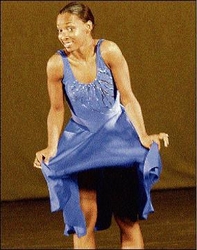
Tovah-Marie Bembridge in a playful mood in Clive Thompson's 'Vignettes of Life'.