Dry dam gets a blessing
Published: Wednesday | August 12, 2009

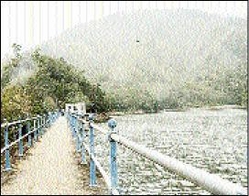
Then and Now: A worker stands over the nearly dry Hermitage Dam in Stony Hill, St Andrew, yesterday. (Below) In this 2006 photo, the dam is at near capacity. Prevailing drought conditions have taken a toll on the more than 80-year-old dam which serves more than 55 per cent of National Water Commission customers in the Corporate Area. - Ian Allen/Staff Photographer
It was almost as if Mother Nature grieved at the state of the dry, parched land yesterday afternoon, as her tears fell from the heavens to soothe the thirsty Wag Water River.
Bubbling with what seemed to be just an ounce of joy, the waters of the river oozed gently into the Hermitage Dam in St Andrew.
"A di most me see it run into the dam fi a long while now," a worker commented as the trickle from the river picked up speed, carrying with it some of the dry sandy banks.
The dam has not seen droughts of the current magnitude for at least eight years, workers say. It is now holding less than 26 per cent of its near 400-million gallon capacity, about half of what it was this time last year.
Old equipment surfaces
It is so dry here that, looking over into the dam's more than 100-foot deep pit, one can see the remains of old equipment which were previously invisible to the naked eye. They now stand out odiously from the gradually building silt with rust flaking from their frames.
The shallower waters in the dam have created a near perfect fishing pond for men in the community, who nonchalantly push their rafts out to the deep centre and cast their nets.
The Hermitage Dam is more than 80 years old.
Designed by the city's engineers, it was completed in 1927 and serves more than 55 per cent of the Corporate Area's households and commercial properties.
Like much of the infrastructure built during its time, its capacity has become compromised by environmental degradation, improper use of watersheds and poor farming practices.
"When you have heavy rainfall, you have a lot of land slippage taking place and all of this will put pressure on your holding facility, hence the whole siltation taking place," said Howard Newell, water production manager at the National Water Commission (NWC).
However, it is also poor maintenance that has compromised the holding capacity of the reservoir. Decades of silt anddebris have made it shallower and there are no plans to clean it soon.
"It's a measure that we have looked at on a number of occasions and we are mindful of the need to have it done," said Newell, who commented that the dam was supported by other sources of water to shore up its capacity shortfall. He made it clear that more emphasis would be placed on improving the NWC's distributing capacity rather than removing tonnes of silt in the dam.
"In anything you are doing, you have to look at the cost-benefit ... If you find that it's more economical to have other investments to improve your water facilities rather than concentrating on the dam ... it is best, based on economics, to look at those sources," Newell said.
gareth.manning@gleanerjm.com