

'Pitchy-patchy' Budget
Published: Monday | April 27, 2009
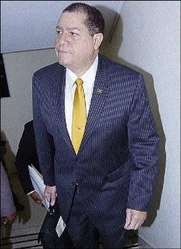
Audley Shaw, minister of finance and the public service, ascends the stairs at Parliament ahead of his opening presentation in the 2009-2010 Budget Debate on April 23. - Norman Grindley/Chief Photographer
I am so glad that Audley Shaw is not the tailor who will make my wedding suit. If he were, I would have to resign myself to wearing pitchy-patchy.
Last week, The Gavel appropriately indicated that not only did the Budget appear not credible, but also that the country should expect to see the first supplementary estimates by September. The writing is on the wall.
The size of the national Budget has already been increased by $8 billion to $555.7 billion, from $547.7 billion, in two weeks. The finance minister has said that the additional amount is contingencies to pay salaries. Now, that seems fascinating to me.
Minister Shaw has crafted a budget and was hoping not to pay retroactive money to the teachers, nurses and soldiers and even before the Budget Debates have been concluded, he has moved to appease them. We are happy that these groups will be getting some money; we celebrate with them, but surely, this is not looking good for the finance minister.
Not only is it untidy to be tacking on this huge sum to the Budget, but it also begs the question of what else the minister will finally realise that he cannot go through the fiscal year without spending on.
We are yet to see the approved spending following the Standing Finance Committee's meeting, but we sincerely hope that key adjustments pointed out in this column last week were made.
Minister Shaw may be thinking that The Gavel is glad to have him as a punching bag and may be picking on him unnecessarily, but before he cries foul, let's make it clear that we consider the national Budget not to be a culmination of figures as it is now, but rather, a masterful blueprint for financing government policies and programmes.
Eloquent but incomplete
Sad to say, but the 2009-2010 Estimates of Expenditure does not quite make the grade. We suspect that not long from now, the folly of Shaw's budget will be exposed even more, but we hope that it does not unravel to the point where we all become naked.
However, the minister's contribution to the Budget Debates has done very little to leave us feeling that he has a great handle on the situation. Thursday's presentation, to open the debates, was eloquent and well-delivered but, at best, incomplete.
We are baffled as to how Shaw will raise $7.5 billion in GCT from items such as noodle soup, salt and rolled oats, live birds and fish and data-processing units. Indeed, it is strange that even though the minister has plans to collect this vast amount from these items through new GCT returns, the complete list of item is still not known.
We hear that it has now gone to Cabinet for the decision to be made and for the country to know, nearly one week after opening the Budget Debates, what previously exempted items will now be subject to GCT. While Cabinet prepares to finalise the list, we continue to rack our brain as to why it is necessary to tax salt.
In the meantime, we are saddened by the Government's decision to shift from income-based taxes to taxes consumption.
Spread the burden

The Gavel
We understand the need to spread the burden of taxation among all Jamaicans and to capture those who have spent years and decades evading the tax man. However, the special-consumption tax on gas, which is to yield $13.32 billion of his $18.15 billion in new taxes this year, is a cruel tax on the poor.
While Minister Shaw is adamant that the additional $8.75 on each litre of petrol that has to be paid by motorists at the pumps must not be passed on the commuters, we all know that all consumers will have to dig deeper into their pockets because of this and it will only result in greater hardship for the man with less disposable income.
We welcome the increase in the income-tax threshold, but dread the fact that Government is using the easy way to collect revenue. The decision to continue and broaden taxation on consumption is an admission of its failure to collect money due to the state through other gazette forms. Year after year, we hear of the billions of dollars in taxes that businesses refuse to pay over to the Government. Since getting this money is so challenging and successive administrations have demonstrated that they are unwilling to risk political contributions by targeting businesses to pay their full share of the taxes, the consumers have become the feeding tree of the taxman.
The tax answer
We are disappointed that minister Shaw did not find it necessary, in his opening presentation, to outline in detail the Government's plans to catch tax cheats - not just the estimated 200,000 self-employed persons who have not been paying income tax, but businesses - big and small - which steal the GCT they collect and pay whatever corporation tax and other statutory taxes they feel. If he had done so, then at least we would have got an understanding of the tax frame-work for years to come.
We hope the minister does not consider his new forensic-monitoring unit to be the answer to tax reform. While we await the details of how the unit will function, we hope that it does not just add another layer to government units, offices and departments. Already, we are paying people to track down cheats. A new unit is not what is required. What is required is the will to collect from those who have refused to pay and engage in all manner of skulduggery to avoid detection, leaving lazy technocrats to turn on the poor consumers to carry the country's cross.
thegavel@gleanerjm.com