

Sheltering the poor - Food For the Poor helps ease housing crisis
Published: Tuesday | April 21, 2009
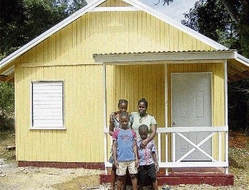
Members of a family in Simon district, Sligoville in St Catherine, stand outside their new home recently donated by Food For the Poor. - Contributed photos
Safe, secure shelter is a basic human right: A human right that many Jamaicans do not enjoy.
That's why Food For the Poor, the United States-based international charity with roots in Jamaica, has teamed up with donors from Jamaica, USA and elsewhere around the world to provide the security and dignity of a home to thousands of Jamaicans.
Food For the Poor says it is living the admonition of Matthew 25:40 - "As often as you did it to one of the least of My brothers and sisters, you did it to Me."
"For those who could never afford a home of their own, a new Food For the Poor house is a miracle and an answer to their prayers," says the entity's president and chief executive officer, Robin Mahfood.
"A new home restores dignity and renews hope for families living in poverty," he added.
The organisation has constructed more than 54,000 houses in the Caribbean and Latin America for people desperately in need of adequate shelter. Food For the Poor operates in 17 countries in the region.
Thousands of homes built
Although thousands of those homes have been built in Jamaica, chief operations officer of Food For the Poor Jamaica, Ron Burgess, says the local charity now has more than 12,000 applications from needy Jamaicans seeking a home.
"We are committed to doing all we can to respond to this cry from the most needy," Burgess, a deacon in the Roman Catholic Church, said.
Last year alone, Food For the Poor built 8,417 housing units for families in need of shelter. Nearly 2,300 of those housing units were donated to Jamaican families in dire need of proper shelter. The organisation is hopeful that it will be able to provide shelter to even more Jamaicans in 2009.
"We are happy when, through the generosity of our donors, we are able to increase our ability to respond to the housing need of the poor," said Burgess.
While some donors are numbered among the more affluent here and abroad, many are ordinary, working-class people, who give their 'widow's mite' contribution to help others find a place to lay their heads.
American Barbara Gilbert is one of them. Gilbert, a single mother, and former waitress turned social services worker, first came to Jamaica in 2005 where she witnessed the critical housing crisis first-hand. Then and there, Gilbert vowed to give a Jamaican family a house each year for the rest of her life. True to her word, Gilbert has built Barbara's Village in St Catherine, providing homes for 14 destitute families. Through her fund-raising efforts, an additional 70 houses have been built by Food For the Poor throughout Jamaica.
"My name is Barbara and you are all my family. Your burdens are my burdens and you give me so much more than I could ever be able to give you. I don't own a house and I probably never will because my money is going to go to keep building houses in Jamaica for the rest of my life," she told the families at the handover of the homes.
Earlier this year, Food For the Poor raised money from a gala event in Palm Beach Florida to build another 55 houses in Jamaica, taking it a step closer to meeting the goal of satisfying the huge demand that exists for housing assistance. Palm Beach philanthropists, Robert and Arlette Gordon and Andres and Cathie Fanjul, spearheaded the event.
The Palm Beach gala is one of the many events put on each year by Food For the Poor to raise money for its projects.
Food For the Poor's executive director, Angel Aloma, noted that since 2005, much-needed housing has been built in Jamaica, and several communities continue to be transformed from money raised from the charity's fund-raising events. Communities in Jamaica built from funds raised at previous Palm Beach galas are Cow Bay fishing village in St Thomas, Bull Bay fishing village in St Andrew and Gordon's Cove fishing village at Bluefields in Westmoreland.
Economically viable fishing villages
The communities are developed around the creation of sturdy housing and economically viable fishing villages with fishing boats, outboard motors, GPS locating equipment, fishing tackle and coolers, safety equipment, gear shed, freezers and extensive training in deep-sea fishing and the marketing of their catch.
"In the renovation of Gordon's Cove fishing village alone, the residents are prospering with the addition of housing, a school, sanitation, access to potable water and fish-processing facilities. It's a complete community that we are building," noted the chairman of the Palm Beach gala committee, Paul Marino.
The gift of a home from Food For the Poor is free. "Food For the Poor has never asked housing recipients to pay housing costs of any kind. We would never charge application fees, construction fees or rent for any of the homes we build," the Food For the Poor Jamaica board chairman, Roman Catholic priest, Father Burchell McPherson, said.
"We receive freely and freely do we give."
Food For the Poor is ranked as the largest international relief and development organisation operating in the United Sates. With more than 97 per cent of all donations going directly to programmes that help those in need, the charity provides food, safe shelter, necessary medical care, educational materials, support for orphans and the aged, emergency relief and other vital services to the poorest of the poor in the 17 countries in the Caribbean and Latin America in which it operates.
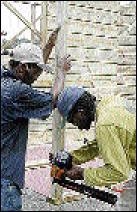
Workmen contracted by Food For the Poor constructing a home for a needy Jamaican family