Rosemary Parkinson, Contributor
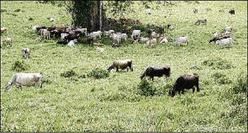
Cows in St Ann graze on grass, as they should.
- Photo by Rosemary Parkinson
I have just finished reading an excellent book by Michael Pollan. It received the 'One of The Ten Best Books of The Year - The New York Times Book Review Award'. There were moments when I thought I would never eat again. I was in such a traumatised state, the organic farmers in the Bridgetown, Barbados market saw more of me than ever before as I bypassed any other possibilities until I could assimilate all this new-found although suspected knowledge.
Omnivore's Dilemma takes you on a ride of what America is doing to food, giving us "a wide-ranging invitation to think through the moral ramifications of our current eating habits". Pollan shows that America's average human body is mostly made up of corn - since from the growing of corn to the eating of nearly every food (specifically processed food), from poultry, beef, sheep and farmed fish, including pharmaceuticals and vitamins, there is some corn in them!
No wonder, he claims, America has become a fat nation. I found myself in the grocery reading every label I could find to see if corn was contained therein. Although I try never to purchase food that is not grown or processed in the islands, it was the horrid realisation that many of our processors import stuff from America to process that got me. Lawd again.
The worst part is that Pollan says that labels sometimes don't even say corn, but use one of the myriad other names given to it in order to hide the fact that it is corn. To add insult to injury, American scientists have corn growing all over the corn-growing lands that has pesticide already genetically placed into this plant. The Aztecs (and still today people from Central America) consider corn to be 'godlike' and treat it with the utmost respect. Not America, says he. Corn is not only in everything but its growing and transportation across the vast lands contribute to being one of biggest fuel users in the country.
Clean meals
Life as an omnivore is not easy. Pollan tells those who are so interested in keeping healthy that wild meat, wild mushrooms, home-made bread made with 'wild' yeast, wild fruits, all give clean meals. Now I know why all my hunter friends in Montego Bay who only eat from the wild look so damned good - their bodies tight and toned. According to Montego Bay's Ramon Vernon, "If I don't shoot it during shooting season, or don't catch it in the sea or river, I don't eat it."
One look at his body and you know that what Pollan says has to be right! But what do I do? I can hardly see myself running through fields of cow dung looking for mushrooms (I understand some of them are so 'hallucinogenic' I might spend the rest of my life in an asylum). The other alternative is scouring rivers and seas with a fishing line or net, or running through makka-bush looking for a large wild hog to take home, slaughter and dress in order to have a little alimentation. Then came Pollan's second book. In Defence of Food, basically follows by informing as to how to eat as best we can. Praise be.
Pollan does remind readers that this is all about America. That many other countries do not have their same problems, yet. So there's hope for the Caribbean. But I fear, knowing as much about food as I do, we might be very close to losing it. For instance, I discovered that the feed from our feed mills includes corn from America (if I am wrong do let me know!) and that chickens, pigs and cows are fed this.
Buy from 'country'
Oops! But I have a choice, I can buy from 'country' where small farmers cannot afford to buy meal and animals are fed as they should be. Cows are herbivores whose bodies are only suited to eat grass, chickens love worms and all those lovely little bugs created by cow dung, and pigs - well, throw anything left over to a pig and he is not only happy like when he's in mud but he's one lucky piece of pork.
Back to Defence of Food. Pollan's advice is: Eat food. Not too much. Mostly plants. "Like eating a little meat isn't going to kill you, though it might be better approached as a side dish than as a main," he says. And then, I quote: "For a while it used to be that food was all you could eat, today there are thousands of other edible food-like substances in the supermarkets.
"These novel products of food science often come in packages elaborately festooned with health claims, which brings me to another, somewhat counter-intuitive, piece of advice: If you're concerned about your health, you should probably avoid products that make health claims. Why? Because a health claim on a food product is a strong indication it's not really food, and food is what you want to eat."
Space does not allow me to give readers the full 'monty' on these two books. But they are definitely worth reading thoroughly. And I leave you with one of Pollan's strongest bits of 'rocket-science revelations' - eat what your grandmother used to prepare surrounded by your family; leave out the grab-through-a-window-and-eat-in-the-car-syndrome and perhaps we just might be on our way to a healthier life.
Coffee growers have lost one who fought for the independence of coffee producing, one of Jamaica's best. Alex Twyman is now showing angels the beauty of real coffee.
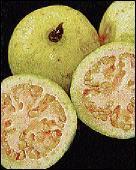
'Wild' fruit, such as guavas, are healthier than anything imported.


















