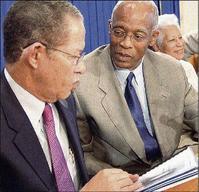
Prime Minister Bruce Golding (left) in discussion with Justice Hugh Small at Jamaica House yesterday. Occasion was a ceremony to present Golding with the report which he had commissioned to review the country's libel and slander laws. The 12-member committee was headed by Justice Small. - Rudolph Brown/Chief Photographer
Prime Minister Bruce Golding was yesterday presented with the much-anticipated report on the country's libel and slander laws, and is expected to discuss the document at the next Cabinet meeting.
Justice Hugh Small was mandated by Golding to lead discussions and consultations on a review of the libel and slander laws to facilitate greater openness and transparency in governance, with a view to empowering the press to undertake more investigative journalism.
"I will recommend to Cabinet that they give serious consideration to those recommendations that have been made and to proceed to seek their implementation through such means ... (which) would involve legislative action," Golding told reporters yesterday at the presentation ceremony.
The prime minister, who has seen a preview of the report, met with the 12-member team yesterday at Jamaica House to discuss the finished product.
Several aspects considered
The Justice Hugh Small-led committee solicited the views of Jamaicans through community consultations, via email and other methods. The committee considered several aspects of the law, including responsible journalism; questions relating to damages offered to an injured party; the effect of an apology for a mistake; the role of new technology, such as wire service; the role of judge and jury, and the time frame in which persons claiming to be injured can file suits.
The current libel and slander acts have been on the books since the Morant Bay Rebellion of 1865.
Media interests have long argued that many elements of the current legislation are a hindrance to investigative journalism. There has also been discontent over the fact that libel is considered criminal, and that sums awarded for damages are often of a magnitude that could force media houses to close their doors.
Protecting one's reputation
Golding told the gathering that people's reputation was an intrinsic part of their very being, and they deserve to be provided with protection against any undue action on their reputation.
At the same time, he noted that a democratic society has to be an informed society, and in the absence of information there was much room for the abuse of people's rights.
The prime minister commended the committee for its work, noting that the members were faced with contentious issues.
He said there were issues that were referred back to the Government because they were difficult for the committee to have consensus on.
The prime minister said Cabinet would examine those issues.
In his remarks, Justice Small said the report gives the Government the opportunity to modernise the libel laws, adding that he was certain that it would not be shelved.


















