
Kenneth Gardner
If you have suddenly decided to engage in a full body building workout, you are likely to experience severe muscle soreness the day following the workout. It is essential that you start your routine slowly and gradually increase the workout intensity.
Expert weightlifters normally start each new programme with one or two sets fewer of each exercise then progressively add sets until they reach their programme goal. They tend to use lighter weights to avoid or at least minimise soreness, and then progressively work up to heavier ones in each movement.
Novices in weightlifting should start the programme slowly. A break-in period can be as short as two weeks, depending on how conditioned you are from participating in other sports or as long as four weeks if you have been living a sedentary life. If you have never lifted weights, your first workout should include only one set for each listed exercise, using relatively light weights. Do not attempt to increase your training poundage (amount of weight you are lifting) until you have completed the full number of sets listed for each exercise in your programme.
Stiff muscles
After each succeeding workout, you can add a total of three to four new sets until you have reached the highest number of sets listed for each exercise. It is recommended that you only add one or two sets if your fitness level is low or as many as three to four if you are extremely fit. Starting your programme slowly will surely help to alleviate stiff and sore muscles.
Even after following the suggested procedures, you could still experience mild to moderate muscle soreness. The prescribed remedy for muscle soreness is one or two long, hot baths each day, but a good workout will also help to reduce the soreness. Regardless how sore your muscles are, proceed to your next workout.
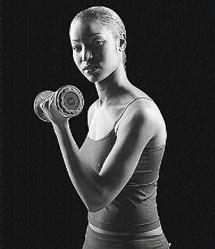
Here is a list of weight training exercises for you.
Bench leg raises (abdominal exercise)
Lie on your back on a flat exercise bench with hips at the end of the bench.
Grasp the edges of the bench behind your head to restrain your upper body.
With legs together, raise your feet upwards until they are directly above your hips.
Return to start and repeat movement.
Hyper-extensions (back exercise)
Stand in the middle of a hyper-extension bench facing the hip pads.
Lean forward and place hips on the pads and hook your heels beneath the small pads behind you.
Keep leg straight for the entire set.
Place hands behind head.
With torso hanging downwards, raise from the hips until your torso is parallel with the floor.
Return to start and repeat movement.
Prone incline dumb-bell curls (biceps exercise)
Grasp two moderately weighted dumb-bells and lie face down on an inclined bench.
Arms should hang straight downwards from your shoulders.
Rotate wrists so palms are facing forward throughout the movement.
Keep upper arms motionless.
Curl dumb-bells directly forward and upward to the shoulder.
Return to start and repeat movement.
Standing leg curls (thigh exercise)
Stand facing the machine and hook your right heel under the roller pad.
Press your right knee against the restraint pad.
Straighten leg and grasp the machine to restrain your upper body.
Use leg strength to curl the roller pad to a position where your leg is fully bent.
Return to start and repeat movement.
Kenneth Gardner is an exercise physiologist at the G. C. Foster College of Physical Education: email: yourhealth@gleanerjm.com.
Letters: Eat dinner for breakfast
Dear Ms. Thompson,
The Sabbatical diet to me has one good thing: it encourages people to have breakfast. Too many of us skip breakfast and this causes us to binge later in the day. That said, it contains numerous inaccuracies - one in particular is the harping on cortisol. Cortisol is actually very good and any spike in secretion is due to underlying conditions (it is these underlying conditions that must be addressed).
Also, not everyone's body handles carbohydrates (especially a lot) well early in the morning (even if they are not diabetic). So, a diet that pushes that, generally is flawed.
- Tony
Send questions and comments to our health specialists at Your Health, c/o The Gleaner, 7 North Street, Kingston; email: yourhealth@gleanerjm.com. Unless otherwise indicated, letters and the specialists' responses are usually published in our letters section and in our articles.


















