Dr. Jephthah Ford, Contributor
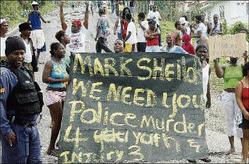
One of the banners mounted by residents of Ros in Montego Bay in this November, 2006 file photo, during a demonstration in their community. The residents accused the police of being involved in a shooting incident in which four men were killed. - File
The issue of police excess and abuse has plagued the country for decades, with reports of extrajudicial killings giving Jamaica a bad image internationally. More critical, however, is the fact that such excess and abuse on the part of law enforcement officers serve to drive a wedge of distrust between communities and those sworn to protect them.
Just one month into the new Jamaica Labour Party administration, there have been more reports of police excess, with at least four cases of questionable police shootings, three of which resulted in deaths. There was much public outcry over the shooting deaths of a pregnant teen and a 26-year-old man who was, reportedly, on his way to work, both of Hampstead, St. Thomas, three weeks ago.
That same week, in central Kingston, a nine-month-old infant was caught in the exchange of gunfire between gunmen and a member of the Jamaica Constabu-laruy Force and has since been hospitalised. A St. James community was also in an uproar two weeks ago over the killing by police of one of its own. And Grants Pen, St. Andrew, has been the scene of angry protests, following the fatal shooting there of an 18-year-old youth. In each case, there were the usual two sides to the story. The police ususally claim they are fired upon and that they return the fire, while residents usually claim the victims are killed in cold blood.
Below is an edited version of an article outlining steps that could be taken as part of the reform of the police force, to improve the situation. The article was contributed by well-known medical doctor, politician and businessman, Dr. Jephthah Ford, who himself was battered by the police six months ago at a dance in Portmore, St. Catherine. He has not been able to practise since he was released into the care of his twin brother, who is also a medical doctor.
To begin with, Dr. Ford said as a country we should openly acknowledge that the police are public officials. As such, a pubic statement should be issued, signed by the police commissioner, acknowledging that the police are public officials and that the public has the right to know the name, rank and badge number of every policeman and woman in the island at any time. Said police personnel must at all times carry such identification.
STATE CLEAR EXPECTATIONS AND STANDARDS
This requires all divisions of the Jamaica Constabulary Force to post complete copies of all rules governing police conduct, for example, the abbreviated police manual, policy handbook, procedure guide, among others.
PROVIDE ACCESS TO PERSONAL RECORDS
Implement a system providing for the independent custody and permanent retention of complaints filed against police personnel, as well as personnel files in general. These records must be freely accessible to citizens, through the Access to Information Act. At least two copies of each complaint must be retained, one of which shall be available only to authorised non-police-affiliated personnel. This is to ensure that no documents are 'lost'. The Citizen Review Board (CRB) (see below), shall have custody and control of these records.
STRICT DRUG AND ALCOHOL TESTING
It must be required that all prospective police personnel pass a comprehensive drug test before being hired. They should also be required to undergo a random urinalysis on a quarterly basis. Additionally, police personnel who are the subject of a complaint, should undergo a urinalysis within one week of the filing of the complaint. Those involved in any use-of-force incident should also undergo a urinalysis within 24 hours of the event. Also, police who are involved in vehicular collisions should be subjected to urinalysis and blood-alcohol tests within three hours of the accident. The CRB shall have custody of these records.
MANDATORY PSYCHOLOGICAL EVALUATION
This would require all prospective police officers to pass an exhaustive independent psychological evaluation before being hired. Further, they would be required to pass an exhaustive independent psycho-logical evaluation on an annual basis. Failure to achieve an acceptable evaluation shall constitute immediate and mandatory grounds for termination of service. The records of all exams shall be retained in perpetuity, but will be publicly accessible only via legal reports in the courts. The CRB shall have custody and control of these records. There should also be mandatory background checks for all police personnel. As such, they should be required to pass a rigorous cross-jurisdictional background check before being hired. This background check must encompass all of the following aspects: criminal records; credit reports; employment history, including verification of employment and interviews of previous employers and co-workers; credential verification, including education and training claims; records checks, including interviews with former landlords and room-mates; civil court record check, with particular emphasis on domestic disputes. They should all do a polygraph test.
RIGOROUS PHYSICAL CONDITIONING
Persons desirous of becoming members of the JCF should be required to pass a rigorous physical examination prior to being hired, and annually thereafter. No adjustment of these will be allowed for any applicant or officer, including women or handicapped individuals, since weak or otherwise unfit individuals are more likely to resort to deadly force. All applicants who fail any aspect of police academy training should be rejected; the minimum age of applicants should be 25. The minimum educational requirement of applicants should be increased to at least sixth form standard. Again, the CRB shall have custody and control of the records of all recruits.
PROHIBIT THE TRANSFER OF MILITARY EQUIPMENT TO THE POLICE
Police departments should not have military equipment, including some types of machine guns, sniper rifles, specialised military ammu-nition, armoured personnel carriers, bayonets, sophisticated surveillance technology, high explosives, and other materials, which are totally unsuited for domestic use. Military equipment was not designed or intended for police personnel to use on the domestic population, but rather was intended to increase national security in the global arena against actual or potential enemies, primarily by conferring the ability to kill in the most effective manner possible. It is entirely inappropriate and exceedingly dangerous for police departments to be given these supplies as a matter of fact. Specialised units may be formed as exceptions to this general rule.
PROHIBIT OFF-DUTY OFFICERS FROM SELLING THEIR LAW-ENFORCEMENT SERVICES TOTHE HIGHEST BIDDER AND FROM USING PUBLICLY-OWNED EQUIPMENT FOR PERSONAL BENEFIT
Off-duty cops often moonlight as private-sector employees. For example, they work as security guards, traffic-directors, funeral-procession escorts, bouncers, gate-checkers, among others. In most cases, the police vehicle, to commute, and other taxpayer-financed equipment are utilised on such jobs. However, cops may be allowed to use police vehicles to commute to and from their homes. All of the costs associated with such private, for-profit use of public equipment is passed on to the taxpayer. Clearly, the police should be prohibited from using any publicly-owned equipment for personal gain. On a closely related note, police personnel should be prohibited from selling their law enforcement services to private entities. Private entities should not be permitted to hire and direct the actions of armed governmental actors who have the legal authority to detain, arrest, jail, or shoot those who the hiring entity may dislike.
DEMOLISH THE 'BLUEWALL OF SILENCE'
Police personnel are well-known for sticking together 'through thick and thin'. Unfortunately, that predisposition extends to protecting their fellow officers from the consequences of criminal conduct. Commonly known as the "blue wall of silence", this pervasive conspiracy can take many forms: falsely testifying regarding the criminal conduct of fellow police officers; actively covering up the criminal conduct of fellow police officers. Any officer who fails to adhere to the stricture of this notorious 'code of silence', is quickly made to suffer the consequences, (of which ostracisa-tion is the least severe). For all intents and purposes, this unwritten code, which is inextricably embedded in police culture, duplicates the infamous Mafia code purposes, of 'omerta', but the consequence for security personnel is much worse. To effectively dither the police from enabling their fellow officers to perpetrate criminal conduct with impunity, severe sanctions must be imposed on those with unrevealed knowledge. New laws must be passed which make it a felony, punishable by at least two years in prison, for a police officer to fail to report, at the first possible opportunity, any misconduct of which he has personal or hearsay knowledge. Furthermore, engaging in any act which helps to conceal or enable criminal conduct, must be categorised as a felony punishable by at least five years in prison. In either case, the transgressing officer must also be charged as an accomplice to criminal conduct which he failed to disclose (that is, he must, in addition to being charged with failure to disclose, face the same charges and punishment as the officer who actually engaged in the criminal conduct).
MODIFY USE OF FORCE POLICY
In all instances, the police are legally authorised to use force, (up to and including deadly force) if they feel afraid for their safety.
This is true regardless of whether the basis of their fear is reasonable. In other words, it is perfectly legal for a police officer to kill you based solely on his own subjective perceptions, no matter how unreasonable those perceptions may be. Such a nebulous and variable standard encourages a wanton disregard for human life, and gives the police virtual carte blanche to kill civilians. To remedy this extremely dangerous state of affairs, we must replace the 'subjectively reasonable' standard with the 'objectively reasonable' standard. Police authority to kill civilians must exist only under objectively reasonable circumstances.
In other words, a policeman should be authorised to use deadly force only if a reasonable person under the same circumstances, would have been in justifiable fear of their life. In the absence of such justification, any intentional death caused by the police must be charged as a murder.
THE USE OF SO-CALLED LESS-LETHAL WEAPON
Increase the availability of weapons, which are proven to be non-lethal. Provide intensive training in the proper use of such weapons. Revise policies regarding the use of traditional firearms to discourage the unnecessary taking of human life. Require that each police officer who uses any type of force, or who witnesses the use of any type of force by a fellow police officer, file a written report. Require that each police officer who unholsters his gun, or who witnesses a fellow police officer unholster his gun, to file a written report.
Any police officer who fails to file required use-of-force report would have his service terminated.
THE RIGHT TO VIOLENTLY RESIST FALSE ARREST
Formally reaffirm the traditional right of a citizen to use proportional force, (up to and including deadly force), to resist false or unlawful arrest. This is a long-recognised common-law right.
CONDUCT ANNUALANTI-CORRUPTION AUDITS OF ALL OFFICERS
Conduct an annual credit check on each police officer, to ascertain (a) if the officer has established a credit limit exceeding the statistical average of an individual in his income bracket; or (b) if the officer has accumulated an unreachable debit load, (since the demands of such a debit load could tempt him to generate revenue through illegal means).
In the absence of a verified explanation, any officer found to have a credit limit which exceeds by 10 per cent the average credit limit of individuals in the income bracket would be subject to an independent audit and investigation.
EFFECTIVE CITIZEN REVIEW BOARD (CRB)
Create Citizen Review Boards, (CRB), to review all allegations of police misconduct. To ensure that the actions of the Boards are effective, unbiased and thorough, they must be endowed with the following characteristics:
Members must be carefully appointed; apply to the Governor General for appointment and be carefully screened;
They must be empowered to apply to the court for instructions to be given to the police department;
They must be empowered to suggest punishments upon mal-feasant officers, up to and including termination of employment without benefits;
They must be authorised to offer rewards, (including vacation time and bonuses), to officers who report wrongdoing in the ranks;
They must be empowered to direct the actions of the Integrity Testing Units;
Board members must be totally insulated from the police department and police personnel;
Ex-prate contact between Board members and the parties must be strictly prohibited;
No member of the CRB can be current or former employees of any law enforcement department;
CRBs must be fully funded and staffed, and include an independent attorney and private investigator;
They must be completely outside the political chain of command;
The board's meetings, agenda and notes must form part of the public record and be accessible under the Access to Information Act.
LEGALISE CITIZEN MONITORS
Citizens must be empowered to record their interactions with the police and all other government officials in their official capacity. Citizens must be free to record all such governmental representatives both overtly and covertly. And these records may form part of a complaint to the CRB.
I am grateful to the managers of copwatch.com for their input and permission to quote from their documents and I hope this treatise will form the basis for serious public discussion as we come to grips with the monster of crime in our nation. The expected benefits are many for certainly I hope that as the trust and friendship is restored with the good men and women of the police force we will all be galvanised to serious work together to rid our country of the evil that that is now threatening to overcome us all.

Ford
Sincerely,
Dr. Jephthah Ford
National Action Coalition


















