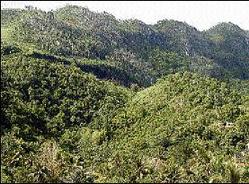
The forests of the Cockpit Country in Jamaica's interior are a world-famous karst (limestone) habitat, home to many plants and animals found nowhere else in the world as shown in this October 11, 2003 file photo. The spectre of bauxite mining here has raised the ire of environmental groups. -
Ian Allen/Staff Photographer
WASHINGTON (Sun-Sentinel.com):
Backed by ocean research groups in Florida, Congress is poised to give developing nations in the Caribbean and elsewhere a chance to pay off some of their debt to the United States by preserving forests and coral reefs.
Every dollar that qualified nations spend to preserve these fragile ecosystems would reduce their debt by a dollar under a bill passed by the House last Tuesday evening and cleared for passage in the Senate.
"This bill is truly a win-win-win situation," Rep. Alcee Hastings, D-Miramar, told the House. He and co-sponsor Mark Kirk, R-Ill., say it would help friendly nations in the Caribbean, South America and Asia while nurturing the environment.
"By providing incentives for developing nations to conserve their coral resources, we are in effect protecting coastal landscapes and maintaining coastal quality of water of some of the most important coral reef ecosystems in the world," Hastings said.
The bill passed by voice vote, a procedure often used when legislation has little opposition.
It extends the Tropical Forest Conservation Act, which provides "debt-for-nature swaps" with 12 nations. Over seven years, these swaps generated US$135 million of debt relief while conserving about 50 million acres of tropical forests.
The bill passed by the House last week expands the number of eligible nations and adds preservation of coral reefs and marine ecosystems, as well as all forests to the programme.
Eligible nations include some of Florida's leading trading partners, such as Jamaica, Colombia, El Salvador, Guatemala and Panama.
Advocates support the bill
Environmental advocates support the bill, as do two research groups in Florida that study reef preservation: the Florida Aquarium in Tampa and the Harbor Branch Oceanographic Institution of Fort Pierce.
"Deforestation and nutrient runoff from agriculture are killing coral reefs in much of the Caribbean. It's even happening in Florida now," said Jan Petri, director of government affairs at Harbor Branch. "A lot of the fertilizer used to grow crops gets washed into the ocean. Seaweeds and sea grasses then grow on reefs, suffocating the corals."
"It could have an impact if there is an economic incentive for nations to preserve the reefs," Petri said. "It helps maintain and encourage tourism, which is the mainstay of their economies."
The Senate Foreign Relations Committee passed a companion bill last month, clearing it for debate by the full Senate on a date not yet set.


















