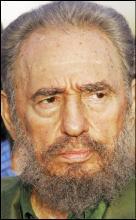
Cuban President Fidel Castro. The U.S., which is hostile to the Cuban revolutionary, continues to finance interests opposed to his regime. - Reuters
HAVANA (Reuters):
When 32-year-old Yoani Sanchez wants to update her blog about daily life in Cuba, she dresses like a tourist and strides confidently into a Havana hotel, greeting the staff in German.
That is because Cubans like Sanchez are not authorised to use hotel Internet connections, which are reserved for foreigners.
In a recent posting on 'Generacion Y' (http://www.desdecuba.com/generaciony/) Sanchez wrote about the abundance of police patrolling the streets of Havana, checking documents and searching bags for black-market merchandise.
She and a handful of other independent bloggers are opening up a crack in the Government's tight control over media and information to give the rest of the world a glimpse of life in a one-party, Communist state.
Taking advantage of area
"We are taking advantage of an unregulated area. They can't control cyberspace out there," she said.
But they face many difficulties.
Once inside the hotel, Sanchez has to write fast. Not because she fears getting caught, but because online access is prohibitively expensive. An hour online costs about US$6, the equivalent of a fortnight's pay for the average Cuban.
Independent bloggers like Sanchez have to build their sites on servers outside Cuba, and they have more readers outside Cuba than inside.
That's not surprising, since only 200,000 Cubans, or less than two per cent of the population, have access to the World Wide Web, the lowest rate in Latin America, according to the International Telecommunications Union.
Only Government employees, academics and researchers are allowed their own Internet accounts, which are provided by the Government.
Regular Cubans are allowed only to open e-mail accounts that they can access through terminals at post offices, where they can also see Cuban websites, but access to the rest of the World Wide Web is blocked.
SCARCE AS TOILET PAPER
For Cuba's freelance bloggers, the difficulties in getting online can mean days, weeks and even months between one post and the next.
"My access to Internet is very irregular," said the anonymous author of a blog called "My island at midday"(http://isla12pm.blogspot.com).
"Like all things in Cuba, one has to resolve the problem of scarcity by hook or by crook, be it Internet or toilet paper," he told Reuters by email.
The Cuban Government blames the limited Internet access on the U.S. sanctions that bar Cuba from hooking up to underwater fiber-optic cables that run just 12 miles offshore, a highway of broadband communication. Instead, Cuba must use expensive satellite uplinks to connect to the Internet via countries such as Canada, Chile and Brazil.
Critics say that is just a pretext to maintain control over the Internet, a powerful tool that some believe could play the same role in spreading information in Cuba as the fax machine played in the dismantling of the Soviet Union.
Cuba has already had a taste of openness since ailing Cuban leader Fidel Castro handed over power last year to his brother Raul, who has encouraged debate at all levels of Cuban society on Cuba's unproductive economy.
But, the reaction to television programmes in December that honoured notorious censors from the early 1970s - when Cuba adopted Soviet policies and cracked down on writers, artists and homosexuals - showed the potential of the Internet to effect change.
There was such a flood of emails from Cuban intellectuals and academics and others with Internet access that the Government was obliged to meet with them and issue an apology for the programme.
PRO-GOVERNMENT BLOGS
Dozens of Government supporters, mainly state-employed journalists with Internet accounts, have blogs. But most of them avoid commenting on the travails of daily life in Cuba and stick to the official line.
Many reproduce columns that Fidel Castro has written from his sickbed, along with criticism of Cuba's ideological arch-enemy, the United States, taken from the state-run press.
One exception is Luis Sexto (http://luisexto.blogia.com), a columnist for the Communist youth newspaper Juventud Rebelde, who recently posted a blistering attack on state bureaucracy.
"Without public criticism, mistakes will continue to hurt our country," Sexto wrote last month.
Others prefer to avoid politics and discuss cinema and literature, or nostalgia for the Soviet cartoons Cubans were brought up on (http://munequitosrusos.blogspot.com).
But Cuba's independent bloggers take a very different line, and prefer to remain anonymous or use pseudonyms in order to protect themselves.
A blogger who goes by the name of "Tension Lia" posts photographs of the ruinous state of Havana's architectural treasures on a blog called Havanascity (http://havanascity.blogspot.com).
The creator of "My island at midday" told Reuters by e-mail that the anonymity of the blog has allowed him to say some things that nobody has dared write about.
"Dissent has always been frowned upon. Intolerance is still the rule in Cuba, even though Cuban society is starting to adapt to diversity of opinions."


















