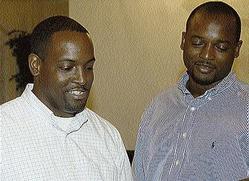
Goodyear Jamaica's top two executives, from left, General Manager Steven Miller and Financial Controller/Company Secretary Andrew Peart in a January 31 Gleaner photo. Goodyear hopes to regain lost business after a fire in January and millions in operating losses on its Jamaican segment last year. - File Sabrina Gordon, Business Reporter
Coming from a dismal financial year in 2006 when profits nosed dived more than 65 per cent and a fire in January that shuttered its tyre distribution business temporarily, Goodyear Jamaica Limited said Wednesday it had lost business but would be hitting the market with new promotions to rebuild share and brand strength.
Though cagey about the size of its market, the tyre company said its aim was to double its sales.
"Inventory is almost 95 per cent back to its original level, and we have a full complement of staff to help regain the dominant position in the market," Financial Controller Andrew Peart told the Financial Gleaner.
"We will be selling the features and benefits of the product to consumers as we don't think that the product is well differentiated in their minds."
Jamaica had a tyre market of 1,008,116 - all imports - valued at just under $2 billion in 2004, according to the most recent data from the Statistical Institute of Jamaica.
Tyre retailers say that in the local market, Dunlop would be Good-year's closest rival.
The quality, they say, is similar but Dunlop is cheaper. A 13-inch 175/70 Goodyear tyre sells for about $2,796 whereas Dunlop's price is $2,082, said one of the bigger tyre outlets in Kingston.
In its first quarter to March, Goodyear posted losses of $3.8 million, saying the warehouse fire had consumed its profits.
Net profit
Last year, saved by growth in its export sales, the company made $25 million in net profit. But that outcome was a shadow of the $73 million recorded in 2005.
Its earnings per share fell to a five year low, from $1.23 to 43 cents.
Nevertheless, Goodyear main-tained dividends to shareholders at $29.7 million, the same amount paid out annually since 2004.
Sales were up during the 2006 period to $1.3 billion, coming from $1.18 billion, but heavy cost of sales eroded the gains. By the end of the period, Goodyear's cost of goods sold had eaten 88 cents of each sales dollar earned, up from 83 cents the year before.
"Increases in raw materials such as oil and rubber, two of the major inputs into our tyres, were unable to be passed on to the consumers, and so these costs had to be absorbed into our operation," said Peart.
Turnover of $562 million from exports to the regional markets in South America, Central America and the Caribbean accounted for 43 per cent of total business, growing by $120 million year on year. Domestic revenue remained flat at $738 million
(2005: $736m).
In fact, Goodyear made a near $14 million operating loss on its Jamaican segment, and $51 million operating profit on its export business.
Peart said sales growth was due primarily to favourable pricing and an improved product mix, saying these would be maintained as target revenue drivers in the periods ahead, but the company is also searching out virgin markets for its tyres.
Goodyear's Selling, Administrative, and Distribution (SAD) costs in 2006 were 9.0 per cent of revenues, which, though representing a higher nominal spend than the year prior, was in line with the tyre company's objective to maintain its SAD expenses at less than 10 per cent of revenues.
SAD expenses in 2006 were $116.5 million, 11 per cent above the $104.5 million recorded in 2005.
To bring sales up in the current period, Peart said Goodyear's strategy will be focused primarily on creating a distinction in the mind of consumers that its products are of superior quality and good value for money.
Goodyear ceased manufacturing tyres in Jamaica several years ago, but retains its distribution business at Spanish Town Road, Kingston. It sells both tyres and tubings, but the latter, according to Peart, is less than two per cent of its business mix.
The company has recently launched a road hazard "Good-To-Go Package", guaranteeing customers special coverage for pothole damage and other mishaps, free membership into a tyre care club, and a manufacturer's limited warranty.
"The focus will be to educate the people to ride with confidence and safety," Peart said.
Looking ahead, Goodyear has identified three primary drivers of business: 'smart product' screening to match price and product with market need, distribution, and marketing and communication.
Goodyear hopes to build an 'exceptional' distribution network by investing more in existing outlets and examining "key geographic void areas" to build sales, in addition to targeted same-store growth, as general manager Steven Miller defined it in a statement to shareholders just released with the company's annual report ahead of its July 16 annual general meeting.
Said Peart: "We must make sure that tyres are available when and where consumers want to purchase them."
That, he said, includes helping its network dealers transform their operations into "world-class retail facilities" and ensuring that each segment of the market is covered.
"The economic environment of our markets, escalating raw materials costs and turnover of personnel were some of the challenges affecting our organisation, and financial per-formance throughout the year", said Miller in his shareholder statement.
Added Peart: "During the year there was also turnover in the two key persons É and this brought about some level of uncertainty within the system as to the direction of the organisation."
Miller was eventually appointed CEO last September, while a month before Peart had his portfolio expanded to include the position of company secretary.
Another director, Veroncia Goldson, has since February resigned the company, according to filings with the Jamaica Stock Exchange.
sabrina.gordon@gleanerjm.com


















