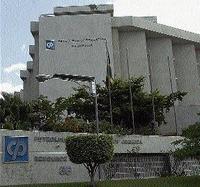
The Petroleum Corporation of Jamaica corporate offices at Trafalgar Road, New Kingston. - FileThe Petroleum Corporation of Jamaica (PCJ) estimates that the fluorescent bulb project to replace four million incandescents with energy savers should ease pressure on 80 mega-watts of Jamaica Public Service Company's generating capacity.
Now the agency is trying to earn money from those savings - the international carbon trading market is now worth US$30 billion - and has tendered for a trader to calculate the credits that the programme represents in reduced emissions and then find a market willing to buy them under 'Emission Reduction Purchase Agreements'.
"We're unsure of the exact kilowatt hours saved. That's to be determined by survey," said Godfrey Perkins of the PCJ.
At most three bids, ostensibly from overseas brokers, were received at the close of tender at 2:00 p.m. last Thursday.
Initially, the PCJ had got five proposals when it first tendered for a carbon trader in March.
But, the process failed to satisfy the Contractor General. At the retendering, at least two locally based brokers opted not to resubmit bids.
Being new to the business, Perkins said PCJ had left it up to bidders to write their own terms of reference.
But the Contractor General said the process was flawed and unfair to parties who were not experienced in carbon trading.
"We had thought the bidders, as the experts, would have incorporated terms of reference in their bids," said Perkins. "But the Contractor General disagreed; said we had to level the playing field."
While Perkins did not say how many bids were received at the close of the new bid round last Thursday, he said they were less than the original five.
CALCULATING CREDIT
To determine the actual electricity savings in kilowatt hours, the records that are being kept by households selected for the bulb project would have to be surveyed, said the PCJ's Godfrey Perkins.
And, to establish the number of credits, the process will involve calculation of the kilowatt con-sumption foregone, matched with savings from the oil JPS would have used to generate the 80MW to power the hot bulbs.
Carbon trading is not new to Jamaica - Wigton Windfarm Limited, which is wholly owned by the PCJ, actually sells its credits to the Dutch at euro5.5 per tonne, according to information tabled in Parliament on June 4, contributing to the company's 'other income' of J$59 million estimated over the two years to March 2007.
Wigton's overall sales were J$501 million over the same period.
It sells its output - at least 7MW or one-third its capacity of 20.7 MW produced from its 23 900kw wind turbines - to JPS at 5.6 US cents/kWh. The price moves to 5.051 US cents after year fives or in 2010.
The renewable energy company's performance is subject to the vagaries of the wind, with this year's output estimated at 35 per cent, or 7.245 MW, of installed capacity.
Wigton has been trading credits for only two years in a nascent sector that continues to evolve, both locally and internationally.
C02 emissions
But since the plant's com-missioning on April 29, 2004 to January 2007, the wind farm has avoided 19,499 tonnes of C02 emissions, "thus 84,285 barrels of oil import have also been avoided", said the ministry paper tabled by Energy Minister Phillip Paulwell.
The result, Paulwell said, was savings of US$4.2 million on the country's oil import bill, calculated at US$50 per barrel.
Elsewhere in the region, Caribbean Airlines is also giving its customers the choice to go 'carbon neutral'.
CEO Peter Davies says 80 per cent of its bookings are paperless, done via five e-ticket partners, according to wire reports; and the airline has installed winglets on its Boeing 737 to increase the air-craft's efficiency and reduce CO2 emissions.
The Trinidad-based airline, which became operational on January 1, has already saved 4,000 tonnes of CO2 emissions, said Davies.
Several of the world's big broker-ages are in the process of adding or expanding carbon trading desks after data revealed that the market had grown 11-fold from US$1 billion in 2004 to $11 billion a year later, and tripling thereafter to US$30 billion in 2006 - according to the World Bank - representing 2,900 per cent growth over the two years.
Last December, the U.S.-based Carbon Dioxide Information Analysis Center (CDIAC), which supplies emissions data to governments, researchers and NGOs worldwide, said emissions have actually grown about 28 per cent over a decade and a half to 2005.
CDIAC estimates that global emissions rose by 200 million tonnes in 2005 to 7.9 billion tonnes, compared to more than 6.0 billion tonnes in 1990.
lavern.clarke@gleanerjm.com


















