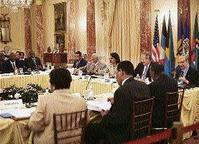
United States Secretary of State Condoleezza Rice (third right, background) hosts the CARICOM Ministerial meeting in the Benjamin Franklin Room of the State Department in Washington on Monday. - ReutersLinda Hutchinson-Jafar, Business Writer
WASHINGTON, Untied States:
CARIBBEAN LEADERS meet with United States (U.S.) president George W. Bush and his Foreign Secretary Condoleezza Rice today, but have already signalled their deepest concerns ahead of the talks.
Yesterday, as the delegations gathered at the World Bank headquarters in Washington D.C., there were calls for increased support from the U.S. and other trading partners for the vulnerable small economies as they grapple with a myriad of social, environmental and economic challenges. Today's meeting with Bush and Rice will discuss strengthening ties.
Worth billions
But yesterday, another member of Bush's Cabinet also signalled that the U.S. expected the region to be prepared to help itself by doing more to create a strong business climate.
"Attracting business and investment will create jobs which helps lift people out of poverty and puts them on the path toward self sufficiency," said U.S. Secretary of Commerce, Carlos Gutiérrez.
Describing trade relations between the U.S. and the Caribbean as solid, the commerce secretary said in 2006, two-way trade was worth US$19 billion. In that year, the U.S. imported $10.4 billion from Caribbean Community (CARICOM) countries.
Between 2004 and 2006, U.S. imports from CARICOM countries increased by more than 26 per cent, while exports increased by more than 32 per cent.
Guitérrez also said the Caricom Single Market and Economy (CSME) offers as an opportunity to strengthen ties and better prepare the region for the global economy.
Pledging U.S. support for the Caribbean, Gutiérrez said there were a number of programmes already in place such as the Caribbean Basin Initiative (CBI) which create opportunity and an environment for progress.
Noting that the Caribbean has taken some very positive steps forward, he said the World Bank's Doing Business 2007 report highlights significant progress in business regulations relevant to startups legal rights of borrowers and lenders, bankruptcy procedures, and contract enforcement.
"But on the flip side, the report also highlights that countries have diverged on implementation of these regulations resulting in wide regional differences, for example, on the number of days to start a business," said the commerce secretary.
Clearly, there is a lot of good news, but still much to be done," he added.
At one of the plenary sessions, Jamaica's Prime Minister Portia Simpson Miller said the conference can only be meaningful if people's welfare at the centre of the deliberations, a theme she carries consistently in international fora.
"The region's high debt-servicing burden, reduced official development assistance, declining terms of trade due to the phase-out of preferential trading arrangements, and reduced demand for tropical commodities and raw materials, have added to the development challenges and vulnerability of the region," Simpson Miller said.
She pointed out that nine Caribbean countries rank among the 25 most vulnerable countriesin the world and 13 are among the 50 most vulnerable.
"The total trade in goods and services of CARICOM states accounts for less than 0.1 per cent of total global trade," said the Jamaican PM.
"This is a miniscule figure, which indicates that any concessions granted to us would not cause any disruption to world trade."
Secretary General of the Organisation of American States (OAS), José Miguel Insulza outlined the main challenges confronting the Caribbean, saying some of them were outside the region's control, leaving countries exposed.
"This vulnerability arises from an inherent exposure to ... energy price shocks, natural disasters, strains posed by migration, the effect of the HIV/AIDS pandemic and the adverse effects of climate change," he said.
Insulza also praised the region's move to create better economies through the CSME noting that the external trade environment has a significant impact on the ability of the region to compete and grow.
"The decision of the CARICOM countries to integrate and further open their economies, negotiating trade agreements collectively, must receive a positive response from their main trading partners in the Americas," he said.
Simpson Miller suggested that U.S. and Caricom commit to promoting trade between them, and that an end be brought to the growing uncertainty about the future of Caribbean Basin Initiative/Caribbean Basin Economic Recovery Act (CBI/CBERA) preferences.
business@gleanerjm.com


















