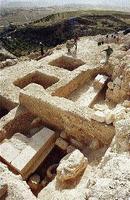
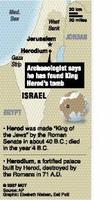
This undated file picture shows the recently discovered burial site of King Herod. - Reuters photosGarth Gilmour, Contributor
The report this week of the discovery of the tomb of Herod the Great at the site of Herodium led me to recall my first visit there. It was hot, the sort of stifling heat that comes all too frequently in the Middle East. It seemed a slow and tiring walk from the car park up the artificially shaped hill; what it must have been like in Biblical times to trek from Jerusalem and then climb to the top was anyone's guess, but Herod made the trip many times. By all accounts, this was his favourite retreat, his most sought-after hideaway, the one of his many magnificent architectural achievements that he found most appealing. And here, by his choice, he was buried.
When I visited the site in the early 1990s, Ehud Netzer, a professor at the Hebrew University's Institute of Archaeology where I was a student who announced the find this week, had already been searching for the Herod's burial place there for some time. The hill, which was artificially raised and then fortified to form a volcano-like cone visible from Jerusalem some eight miles to the north, is riddled with passages and tunnels. The Roman historian Josephus had written that the king was buried at the site, and moreover described in some detail the funeral procession, which included the climbing of a monumental staircase built especially for the occasion.
I remember looking down from the summit where Herod built one palace to the base of the hill, and seeing there the remains of a second and larger palace. Somehow in the semi-arid, desert-like surroundings of the hill this visionary man had built a royal town of such incredible magnificence, that even his other architectural and engineering achievements paled in comparison, at least in his mind. This was the place that he named after himself, and this was where he chose to be buried.
Herod, of course, is known for other reasons too. He was a vicious, odious character whose ambition and cruelty combined with his vanity and engineering brilliance created one of the most vivid characters in history.
He was responsible for the slaughter of the children described in Matthew's gospel. After the magi from the East departed for home after paying homage to the new king, the King of the Jews, Herod's jealousy and paranoia caused him to strike out and command the killing of all the boys up to the age of two. Who can imagine the effect on the population of this carnage, this horrendous murder? And yet it appears that this was typical of the man. He was driven by fear of being replaced, of falling out of favour with the Romans, of being overthrown by the local population.
Questioned identity
His own identity as a Jew was questioned. His ancestry was Idumean, and his Jewishness was largely self-proclaimed. His accession to the throne was controversial and unpopular. He was appointed King of the Jews by the Romans, but tried to curry favour with the local population of Judea by marrying into the Hasmonean family that opposed him. Having married Mariamne, the granddaughter of a former high priest, he set about killing all who he perceived were threats to his position, including eventually Mariamne herself.
At the same time his sycophancy to his Roman masters was extreme. He rebuilt the ancient Israelite capital of Samaria, and renamed it Sebaste after the Greek form of the name of his mentor, Augustus Caesar. He built Caesarea on the coast and named it after Augustus again. The temple that dominated the skyline of the city, and was visible for miles out to sea, was built in Augustus' honour too.
So Herod sought to keep the Romans happy and the people quiet. His most enduring project, the expansion and beautification of the temple in Jerusalem, was also his most overt public relations exercise.
Most beautiful structure
The small temple that had been rebuilt after the return from exile in Babylon some 400 years before, was transformed into the most beautiful structure in the world. Herod built a massive platform measuring some 500 by 300 meters to surround and support the temple, known today as the Temple Mount. He bounded the platform with a colonnade and augmented and beautified the temple itself. So massive was the project that it was never completed. After the destruction of the city, along with the temple, by the Romans in AD 70 the platform remained in place, and is still there today.
The most famous of Herod's building projects is Masada, the incredible desert fortress at the Dead Sea, surrounded by a wall around the summit, with a swimming pool, bath house, synagogue, two sumptuous palaces, one of which hangs magnificently and precariously over the side of the mountain, and cisterns containing enough water that none ever needed to be imported to the site. Familiar to tourists from all over the world, it is Masada that gives us the most vivid illustration of Herod's architectural and engineering brilliance. The man was able to visualise a city, or a temple, or a mountain palace or town before even the first stone was laid. And he had the power to realise his dreams.
Masada, Caesarea, Jerusalem, Samaria-Sebaste - and Herodium. And these are just some of his achievements. We may speculate on the cruelty of the man, on his paranoia, on his duplicity. We may marvel at his achievements, be amazed at his architectural heritage. We may decry his opposition to the babe born in a stable in nearby Bethlehem. But we should note that even this man, this Herod 'the Great', even this man died and was buried in a tomb. It is a solemn reminder that whatever our achievements, or fame, or wealth, the grave awaits us all.
Dr. Garth Gilmour is a biblical archaeologist based at Oxford in England. Send feedback to mark.dawes@gleanerjm.com.


















