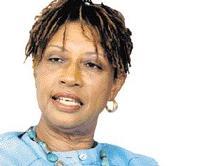
Beverley Anderson-Manley
Many of the popular songs at the end of the first decade of Independence were characterised by their protest content. Songs such as Everything Crash and Johnny You too Bad heralded the disappointment of the majority of the Jamaican people who were abandoned by the process. The fact that "everything crash" also meant that many people became more and more involved in illegal activity in order to survive.
Today, 45 years after Independence, the marginalised masses are still
struggling to find a way to make sense of their lives through a myriad of
informal and often illegal activities.
It is disconcerting that within this process, several members of our society are increasingly
accepting a belief system of dependency. It doesn't help that this belief system is grounded in a dependency that was forged during slavery and colonialism and was critical for those times.
Dependency syndrome
There is the woman, for example, who sees her salvation not in God but in the capacity of some man or men to support herself and her children. Five children and five baby fathers later, she is trapped in a dependency that keeps her stuck and prevents her from being all she can be for herself, her children and her life. Yet as degrading as this process is, for many women, it continues. When given an economic opportunity and therefore a new vantage point on her world, this same woman assumes some level of independence and is able to take care of and respect her body. She is able to plan how many children she wants to have and with whom. She is more aware of her choices. We know that the economic independence of women works for everyone, yet we delay in putting adequate systems in place to facilitate this process.
Then there is the case of the man who proves his manhood by the number of children he has with
several baby mothers. What if fathers could take responsibility for their children? What if mothers could take responsibility for their children? What if we could have the type of development that takes into account the gaps that parents cannot fill - for example, the provision of day-care centres, homework centres and ongoing disciplinary and re-socialisation training throughout the school system - to name just a few.
Building Communities
As the slaughter continues in our beautiful country, the faces of many of our sisters and brothers projected nightly during the television newscasts are often contorted and ugly. Whether they are blocking roads or protesting against alleged police brutality, the trauma, the hate, the violence displayed are not conducive to development.
It is largely accepted that
citizens who block roads do so because they get quick responses from the relevant authorities. Why is it so difficult to bring community members into the participatory process? We must provide a space within which communities can be built with women, men and children who understand clearly that it is the powerful relationships inside the community that builds that community.
When the Women's Movement was in full swing in the 1970s, one of the leading feminists asked the question: "How do we get policymakers to listen"? It is still a useful question. Making policy makers accountable, before the fact, is something we can easily implement.
Communities must know the resources which are available to them and be a part of the decision-making process in the spending and monitoring of those resources. Community members know what is happening in their communities. The State must give communities support so they are accountable and hold their leaders accountable.
It is time to end the talk about the critical importance of community. Government after government says it is committed to community building. What is stopping us? What is missing? Empowering communities makes sense, but it also means a loss of individual power for those who lead us at all levels - as collective power and decision making take over from individual power - all in the interest of Jamaica.
Beverley Anderson-Manley is a political scientist,
transformation coach and
gender specialist. Email: BManley@kasnet.com