
PALS sustains presence in Rollington Town - Programme restarted after extended absence
Published: Thursday | October 29, 2009
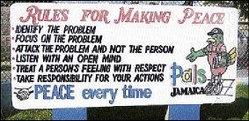
Perky Parrot has a prominet perch, pointing to the guidelines for peace on the wall of the Rollington Town Primary's Library and Resource Centre. - Contributed
If the then Peace and Love in Schools, now Peace and Love in Society (PALS) programme, had been personified in a student, donned a uniform and answered during roll-call at Rollington Town Primary School, it would have been marked absent for some time.
However, PALS proved its sustainability and did not have a marked absence, principal Dr Margaret Bailey saying even when it was not officially active there, the school's administration kept the programme's principles alive.
As guidance counsellor Alton Johnson, who was a class teacher during PALS's first time around at Rollington Town Primary, puts it, "The programme is alive and well. It has never gone to sleep."
And now PALS is officially back at Rollington Town Primary, one of 90 primary and junior high as well as 15 high schools islandwide in which the programme is being implemented during the first phase of a five-year memorandum of understanding between PALS and the Ministry of Education.
Disciplinary problems
Rollington Town Primary signed on to PALS in 1997, Bailey, then a teacher, saying, "PALS came to our rescue in addressing the disciplinary problems." Current grade-five teacher Jacqueline Colley was then in charge of a grade six and says, "Gradually, the children started to focus on what was the problem. We noticed a change in the children's behaviour."
In addition to PALS being on the school's timetable, Bailey says every classroom had a 'Peace Bench' for student-student as well as teacher-student conflict solving.
There is concrete evidence of PALS's initial presence. "We needed a new school sign and PALS sponsored it," Bailey said.
Bailey says that in large part, the fights and violence at Rollington Town Primary were spin-offs of what was happening in the community. And the programme did filter out to the community, as had been hoped. "In the wider community, it had the effect we wanted," Bailey said.
Rollington Town community coordinator Ronnie Wilmot has seen that effect, as 14 persons from Rollington Town and Norman Gardens completed the SuperPALS programme, 10 evening sessions from August to November 1998. He points out that some of the participants, many of whom were heavily involved in community activities, have gone on to other levels of community involvement. So Fabian McGowan is now councillor of the Springfield division in the Kingston and St Andrew Corporation, Kirk Brown is involved in the police youth club, and Alfred Palmer is into community work.
"At that time, the PALS programme was timely. It brought people together. We had conflicts in Rollington Town, but they did not originate here," Wilmot said.
Personal approach
Fabian McGowan says that the PALS approach of thinking before acting, which changed his personal approach, has stayed with him.
"Once you have gone through it (the PALS training), it is hard to lose it. It is not a matter of going back. It has always been there with me, and those are the skills that come out naturally," McGowan said.
Now that PALS has been formally reintroduced into Rollington Town Primary, Bailey says she intends to keep it on roll permanently. "I am currently doing a conflict-resolution action plan so it can be sustained," she said.
Lorretta Henry Grant, PALS trainer assigned to the schools, says, "The teachers are so responsive. When I leave, I am always on a high. They are very keen, very motivated, very receptive."
And Johnson says, "We want to spread PALS across the school so it becomes self-sustaining. By next year or the year after, it will become part of the subconscious.