AAJ - Exceeding expectations
Published: Thursday | October 29, 2009
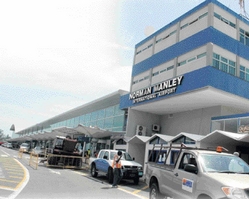
A view of some of the improved facilities at the Norman Manley International Airport in Kingston. - photos by Colin Hamilton/Freelance Photographer
The Airport Authority of Jamaica (AAJ) is the agency responsible for executing the modernisation and privatisation of the island's international airports, projects that are being pursued with a high degree of success.
Established in 1974 under the Airports Authority Act as an independent statutory body, the AAJ has primary responsibility for the nation's airports and four aerodromes. The changes made under the modernisation programme since 2002, especially in Montego Bay, have helped to drive the growth of passengers, mitigating the impact of the economic downturn.
It was in the late 1990s that the Government handed the organisation the mandate of developing and operating a safe and secure airport system and the responsibility for implementing its privatisation goals in keeping with international trends. The AAJ has done an outstanding job since then.
In April 2003, the AAJ divested the operational responsibility for the Sangster International Airport to MBJ Airports Limited, a private-sector operator. The Montego Bay-based facility, the gateway for tourism, has been overhauled and transformed into one of the most modern airports internationally. Five months later, in October 2003, NMIA Airports Limited was born as wholly owned subsidiary of AAJ, with responsibility for operating the Norman Manley International Airport (NMIA).
Doing well
Earl Richards, chief executive officer of NMIA Airports Limited and president of the AAJ, said: "MBJ has been doing well. We regard the operation has one of the more successful privatisations in Jamaica."
Under the agreement between MBJ Limited and the AAJ, the approved airport operator is responsible for the management of the day-to-day operations in keeping with specific performance criteria and prescribed international standards.
Regular performance reviews and other contract administration oversight functions are conducted by AAJ, as specified under the concession agreement. In addition, an airport forum is held biannually to provide stakeholders with the opportunity to provide progress reports and to address pertinent issues.
Under the 30-year concession and lease agreement, operational responsibility will revert to the AAJ unless the agreements are successfully renegotiated. "It suits them to grow the business and it suits us when they do their best," said Richards.
Three-phase programme

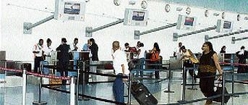
Earl Richards, president of the Airports Authority of Jamaica, examines one of the self-check-in machines.
The AAJ team turned to the Kingston-based airport at the end of the privatisation exercise at the Montego Bay-based facility.
The three-phase capital development programme was developed after a 20-year master-plan study. The major deliverables of phase 1A were the new departure wing and the arrivals/departures two-level passenger pier.
A significantly expanded area is now available for passport control, security screening and a new departure lounge with food and retail concessions. Richards noted that Jamaicans are now able to enter the terminal building to bid farewell to friends and relatives. The immigration hall has also been expanded to get rid of congestion during peak periods and to better facilitate passenger flow and processing requirements.
The immigration hall now includes six automatic ticketing kiosks for passengers to check themselves in. Richards notes that 40 per cent of American Airlines clients now use these kiosks. The intention is to grow usage to 60 per cent of all departing passengers.
An additional technological input has been the use of Common Use Passenger Processing System (CUPPS) which permits interchangeable check-in positions by all airlines and reduces congestion problems. Yet another significant development has been the construction of the NMIA Cargo and Logistics Centre. Additional infrastructure included new security screening facilities, including X-ray machines and an expanded CCTV network.
Best year
NMIA Airports Limited is not on the Government's budget and Richards said that while Norman Manley International has not had the economic success of Sangster International, the NMIA has been working to improve its solvency. Growth in passenger arrivals has fluctuated with the best year being a jump of 8.7 per cent in 2005.
One growth strategy has been to facilitate and support increased tourists flow through the second international airport. NMIA currently receives 50 per cent of the traffic of Sangster International with 1.7 million travellers in 2008 compared with 3.4 million passing through Montego Bay in the same year.
To change this, Richards said: "We are actively supporting tourism development in the eastern end of the island. We are happy about the construction of Highway 2000 which will help. Here at the airport, we have constructed a transportation hall which facilitates the transfer of passengers from the airport to different parts of the Jamaica. Facilities include four rent-a-car agencies and booths outfitted by Sandals, Hilton, Strawberry Hills, the Courtleigh Group and the Spanish Court Hotel for the care and transfer of their guests."
In Boscobel, St Mary, the aerodrome is also being upgraded as an international entry point and will be ready for private jets in June 2010. Upgrading work at Boscobel is expected to cost about $200 million. The runway at the aerodrome will be completed by December 2009.
"This is expected to be a significant complement to tourism development in the area," Richards said, noting that the aerodrome will facilitate big spenders who have homes nearby and do not wish to pass through either international airports.
The NMIA/AAJ is also determined to improve service to the NMIA community itself which includes workers. Facilities at the airport now include over 70 businesses operating around the clock on a three-shift basis. "Rather than focusing on passengers alone, we are also looking at the airport community and making a commercial venture of it," Richards explained.
The businesses provide a greater variety of food at affordable prices. The NMIA Airports Ltd hopes to add even more facilities for the 'meeters and greeters'.
"At the airport, we never stop building," Richards quips. NMIA Airports Limited is also looking at improving water storage and supplies, improving security and cargo capacity and the construction of underground fuelling systems for aircraft on the apron.
avia.collinder@gleanerjm.com