Petrina Francis and Howard Campbell, Staff Reporters
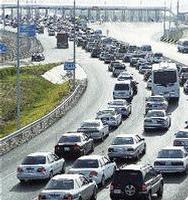
Motorists on the new Portmore toll road. - Norman Grindley/Deputy Chief Photographer
Year 2006 was a tumultuous period for health and education, and it was anything but quiet on the industrial front. The Portmore toll road became a reality, in spite of opposition from residents of the Sunshine City.
A December malaria outbreak in pockets of Kingston, over 40 years after the disease's elimination from Jamaica's shores, triggered concern, and yet another probe was ordered as the media highlighted the plight of hospitals, particularly the Victoria Jubilee maternity facility.
As for education, schools across the island were rocked with violence and a probe was ordered into the delayed Grade Six Achievement Test (GSAT) results.
Some of the year's most eventful moments took place in the industrial sector with two of the most controversial episodes involving the Police Federation and the Nurses Association of Jamaica (NAJ), which clashed with the Government over improved wages and benefits.
Malaria outbreak
The Health Ministry reported on December 1 that there were four confirmed cases of malaria.
The areas initially affected were: Denham Town, Tivoli Gardens, Trench Town and Delacree Park, all in Kingston. Cases have since been found in Rose Town, Wilton Gardens (Rema), Whitfield Town, among other communities in the capital. Cases were also found in Portmore, Sydenham Villas and Church Pen in St. Catherine.
Despite malaria cases continuing to surge and testing being hamstrung by a personnel shortage, the Ministry of Health insisted that they had the disease under control. By year-end, there were over 180 reported cases of malaria.
School scares
Among the schools affected by violence was Vere Technical High School, where five students were shot and injured by a security guard on duty at the institution in November. Subsequently, some education stakeholders called for the removal of armed guards from schools. But the Ministry of Education and Youth said armed guards were needed in schools located in troubled areas.
The matter is now before the court, as the security guard on duty did not have a permit to carry a firearm.
In June, anxious parents and students were forced to wait at least two weeks for the publishing of the GSAT results. The results, which were usually released in the second or third week in June, did not reach all schools until July 3.
The Education Ministry came under fire, and in July Prime Minister Portia Simpson Miller ordered a probe into the delayed publication of the results, amid rumours of irregularities.
The investigation found that there was nothing untoward with the examinations but made several recommendations, including that the Education Ministry look at the number of choices that students have in selecting schools, noting that the current five choices pose a problem for placement.
Sick Hospitals
Meanwhile, Dr. Douglas McDonald, a senior medical doctor at Victoria Jubilee Hospital (VJH), in Kingston, in September painted a grim picture of the conditions at the facility. Contaminated operating theatres infested with roaches and flies and littered with bird droppings, malfunctioning elevators, a nurse shortage, inadequate bed linen and dysfunctional air-conditioning units were some of the woes plaguing hospital staff and patients.
Dr. McDonald had told journalists that doctors sometimes had to walk patients up the stairs to get their surgery done. The Ministry of Health later announced that it would be purchasing new elevators at a cost of $77 million and the hospital received a well-needed paintjob.
Reports also surfaced that same month that a 41-year-old woman lost her baby as a Caesarean section was put off three times due to a malfunctioning autoclave.
The Ministry of Health then ordered an investigation into the circumstances surrounding the death of the baby. Attorney-at-law, Ethlyn Norton-Coke, was appointed to investigate whether the child died of natural or clinical causes.
In October, the special team that investigated the death of the baby identified serious procedural breaches at the institution. According to an official from the Health Ministry, certain stipulated measures were not observed in attending to the pregnant mother, Caroline Edwards-Brown, who had previously lost a child. It was understood that hospital officials also failed to place Mrs. Edwards-Brown under special observation, as customary, given her medical history.
HIV/AIDS at the workplace
Meanwhile, the contentious issue of HIV testing in the workplace emerged again in 2006. JEF Executive Director Jacqueline Coke-Lloyd said employers reserved the right to test for HIV/AIDS.
But Vivian Gray, National AIDS Committee advocacy officer, said this would set back the national fight against the disease "by many years". Mr. Gray said that Government should ban mandatory testing because of concerns that it could be used to screen potential employees, a recommendation the committee made in June to the parliamentary committee looking at the establishment of a charter of rights.
Increased NHT benefits
National Housing Trust contributors got good news in February, when then Prime Minister P.J. Patterson announced another increase in benefits. Effective April 1, the new benefits included a doubling of the loan limit for applicants under the scheme, with open-market and build-on-own-land housing programmes moving from $1.5 million to $3 million per applicant, and up to $6 million for co-applicants.
The loan limit for service lots and house lots also moved from $600,000 to $1 million, and for co-applicants, it will move from $800,000 to $1.6 million.
Industrial negotiations
Led by the combative Corporal Raymond Wilson and Edith Allwood-Anderson, the Police Federation and the Nurses Association of Jamaica, respectively, had several heated exchanges, including road protests and sickouts with the Ministry of Finance before settling with Government late in the year. The nurses inked a two-year deal in August, guaranteeing a cumulative pay rise of 24 per cent. This was well short of the 80 per cent in the first year and 40 in the second they had sought.
Two months later, the Police Federation ended its two-year battle with Government by sealing a 25 1/2 per cent deal. The agreement saw the 7,000 rank-and-file members of the Jamaica Constabulary Force receiving retroactive payments from April 1 to October.
Bauxite sector
The bauxite sector also saw a lot of action. In February, there was a four-day strike at the Alumina Partners of Jamaica in St. Elizabeth where 1,250 workers represented by the National Workers' Union protested for an adjustment in wages that would match inflation rates. They signed a $5.2 billion agreement with the company's management later that month.
There were also turbulent times at the West Indies Alumina Company where a 22-month standoff between workers and management was finally settled after Prime Minister Portia Simpson Miller intervened in March. The workers agreed to a $6 billion package that ensured improvements in wages, education assistance, and travelling and meal allowances.
Cement crisis
Management at the Caribbean Cement Company Limited will want to forget 2006 quickly. In February, the company recalled 500 tonnes of substandard cement sending shockwaves throughout the construction sector, and leading to a general economic downturn in national productivity.
The temporary shortage affected major projects including the renovation of the Sabina Park cricket ground, which will host the opening-round matches and one semi-final of the Cricket World Cup.
Cement from Cuba and Venezuela alleviated the shortage, but the Planning Institute of Jamaica estimated that over 30,000 jobs were lost due to the crisis. Commerce Minister Phillip Paulwell named a seven-member team to assess the cement debacle. Their report, issued in July, was critical of Caribbean Cement Company Limited which it said had not followed Bureau of Standards guidelines.
Sugar divestment
Not all issues that got national attention were resolved. Those included the divestment of the Sugar Company of Jamaica which was announced in December 2005 by then Prime Minister, P.J. Patterson. Ten companies, including two from Brazil, one from India and another from Canada, are among the potential owners of five sugar estates.
Portmore toll road
Last, but certainly not least, is the Portmore toll road. In November, a group of residents from the sprawling St. Catherine community were granted leave to take their case against the toll road operators to the United Kingdom-based Judicial Commission of the Privy Council. They took Government to court after it converted the old causeway which linked Kingston to Portmore, replacing it with a six-lane toll road which opened in July.
Residents say the fee to use the strip is too high. Motorists currently pay $60 for motor cars, $100 for SUVs and $200 for buses and trucks. The case is scheduled to be heard by the Privy Council in March.