Mark Dawes, Staff Reporter
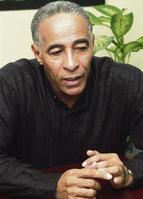
Bishop C. B. Peter Morgan - Ricardo Makyn/Staff Photographer
Bishop C.B. Peter Morgan is challenging the Christian community to re-evaluate how it does ministry in the wake of radical changes on the cultural landscape in recent decades. The Church, he maintains, has an identity crisis, a domineering pastoral spirit, and an inferiority complex.
In a wide-ranging interview with The Gleaner, Bishop Morgan, who is a founding father of the Charismatic Renewal Movement in Jamaica, stressed that the Church needs to evaluate its identity as it seeks to be relevant to the ministry needs of its members and the wider community.
Bishop Morgan, who is the chairman of City Life Ministries, said, "I think in the last 30 or so years, we have seen different cycles of renewal in the Church. From the days of the 1970s and 1980s with the charismatic renewal. Before that there really were 50 years or so of an evangelical revival in the country. Evangelical churches really brought a very strong base to the Church in terms of the centrality of the Word of God, and the significance of one's personal devotion to the Word and the significance of personal salvation.
a new shift
"Today we are seeing a new shift in the Church, and the Church is not able to even understand it at this point. The Church internally is facing tremendous tension, conflicts that arise (from this shift). I believe it is caused largely by the demands that are placed on the Church externally. There are influences that are drawing the Church to respond externally. The Church is a little slow to respond.
"The shift is from what was comfortably regarded as the local church as an entity that was situated at the corner of the road or somewhere central in the city, to which people would go on a Sunday to worship God, be encouraged and go back out to life. To a large extent, the local church was a homogenous group. There was very little mixing between uptown and downtown, rich and poor, educated and uneducated. It was largely male dominated in terms of leadership and female dominated in terms of membership - but nobody rocked the boat. It remained that way. That became the status quo.
"I think that, with the breaking out of the charismatic renewal, a lot of this was destabilised and there is a new emphasis and a new type of worship that came into being.
"There is a new thrust towards personal faith - not just faith to hold on in spite of difficulties and waiting on the rapture - but a new faith that said we can actually draw down on the benefits of Heaven now. And that means that people could be healed, get deliverance from demonic influences and spirits and all that kind of stuff, and people could again believe in miracles. And the poor could just trust God that some wealth would come and people were looking for opportunities through the creative Spirit of god working in them to become empowered themselves. A lot is being challenged again. Even within what has emerged as the charismatic renewal, we see a new settling and, to a large extent, I believe that the Church has developed what I call an introverted complex, which means that it thinks of itself as the purpose for Christ's coming and forget that Christ really came for the sinful world and not for the righteous man."
'domestic-oriented' church
The Church in Jamaica, Bishop Morgan said, largely serves itself and is more "domestic-oriented" than "dominion-oriented" and this is part of its problem, he said. Hence, its leaders are more concerned about protecting their turf because they are controlled by a "pastoral spirit". This, he said, creates an imbalance in the leadership structure and culture of the Church. Leadership in the Church, he said, should not be dominated by a pastoral spirit. Instead, church leadership should demonstrate a better balance in functioning with the five-fold gifts recorded in Ephesians 4:11. Hence, he argued that in addition to the office of pastor, there is need for a greater acceptance and demonstration of the evangelist, teacher, apostle and prophet.
Bishop Morgan who was the senior pastor of the Covenant Community Group of Churches left that body in 2004 following a difference in the vision of leadership the group should embrace.
A star footballer and track athlete when he attended Jamaica College in the 1960s, he said while the offices of pastor and evangelist have attained prominence in the nation, that of apostle, teacher and prophet are lagging in acceptance.
He explained: "The apostolic spirit is a fatherhood spirit and a builder spirit. Fatherhood in the sense of being able to birth, nurture and impart an inheritance. That fatherhood spirit is critical as it has to do with succession and responsibility and impartation. The Church easily accuses leaders of nepotism when, in fact, if you cannot raise your children to succeed you in ministry then you are not even ready to have spiritual children. In the struggle I have been through in recent years with the Covenant Community Group of Churches, I have rediscovered my three biological sons. I realise that I would have lost everything if I had lost my sons. In a sense I lost my church but I gained my sons. And now a whole new movement is developing through my sons. And I am now ready for my spiritual children - a lot of them are gathering around me.
The fatherhood spirit, he continued, is a building spirit - it is pioneering and is concerned with establishing foundations. "We don't have enough of that. Many of our churches are started by evangelists who convert people and don't have anywhere to send them so they become pastors for them. The biblical way is after the evangelist goes in, he calls the apostle who can sit with the experience and be like a consultant.
elders
"Some churches are emphasising eldership which is important governmentally and administratively. But no church grows by elders. No church expands by elders. They are really protective offices in the churches. There needs to be an apostle who is over the elders. The Apostle Paul established the elders and it was his responsibility to hold them to account," Bishop Morgan explained.
The prophetic spirit, he said, has been coming to the fore and there has been increased interest in this gift in recent times. But, he maintains, it needs to mature. It needs to come forth not just as a prognosticating exercise but rather as an ethical imperative that draws people into the demands of righteousness - so that we can align ourselves to God to inherit what He has promised.
In the new cultural landscape, the office of teacher in the Church, he said, cannot be merely the communicating of doctrine, but should also become strongly life-skills oriented. This is not original, he stressed, as many places in the Epistles one will find Apostle Paul teaching life-skills.
The people who worship in churches have been afflicted by an "inferiority spirit", Bishop Morgan said. "They are ignorant about realities in the nation. They don't read and they don't understand what's happening politically and in the business world. They think that they are second-class citizens because they are only pilgrims in this world. They don't really understand that we are here to occupy which means to take charge. We have a disempowered Church.
We have a disempowering culture among our people. People go to church on Sundays and they feel really great but when they go to work they can't really afford to be Christians and make it in the world.
not aware
He warned, churches that are not aware of what's happening around them, can hardly expect to make meaningful adjustment. To illustrate, he said, "I was at 'Genesis'. I watched those young people there jump and gyrate and I know the next time that they go to church they can't gyrate that way.
"I believe that the leadership of the Church faces a great challenge. I don't know if they understand it or fully appreciate it. But it is a challenge that is saying to them, you don't have a handle on the Church.
The priorities of the church today, he stressed, cannot be the same as it was before. Furthermore, the resources that are necessary to invest in the Gospel are not as it used to be. "When I was growing up anything the Church spends must come from believers. The thinking was 'God's work must be supported by God's people'. I have worked with Jamaica Youth for Christ. I have worked with Fun in the Son. It is the big companies that are giving to these Christian concerts and activities. You can't get tithes to do that. It is a whole different dynamic.
"What it really needs is a new breed of leaders who have an understanding of the city, have the discernment of what kind of authority is needed in the city, and can oversee and pull together all of these different kinds of things that are happening at the same time - My point is, how we led in the past cannot be how we lead in the future.
Bishop C. B. Peter Morgan may be reached at bishoppm04@ yahoo.co.uk .
Send feedback on Mind&Spirit to mark.dawes@gleanerjm.com