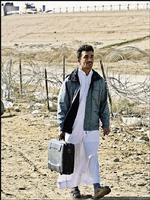
Reuters television cameraman Samir Mohammed Noor walks from Abu Ghraib prison after he was released in Baghdad on January 22, after being held by the United States military for nearly eight months without charge. The U.S. army has been wracked by a prisoner abuse scandal at Abu Ghraib, and only yesterday was hit by new claims of torture in a New York Times report. - REUTERS
NEW YORK (AP):
MEMBERS Of a shadowy United States military unit turned one of Saddam Hussein's torture chambers into their own interrogation cell, where they beat prisoners with rifle butts and used detainees for target practice in games of jailer paintball, according to a report yesterday in The New York Times.
The so-called Black Room was part of a temporary detention site at Camp Nama, the secret headquarters of the unit, known as Task Force 6-26, the Times said. The camp, situated at Baghdad International Airport, was the first stop for many insurgents on their way to Abu Ghraib prison a few miles away.
The Times said the abuse at Camp Nama began as the Iraqi insurgency intensified in early 2004 and continued after photographs of abuse at Abu Ghraib were made public in April 2004, belying Pentagon assertions that abuse was limited to a small group of reservists at that now notorious detention centre.
The report was based on interviews with more than a dozen civilian and military Department of Defence personnel who worked with Task Force 6-26. Virtually all of them were granted anonymity to protect them from retribution by the Pentagon, the Times said.
The critics said the harsh interrogation techniques practised at Camp Nama yielded little information to help capture insurgents or safe American lives.
Many of their complaints are supported by declassified military documents and email messages from FBI agents who worked with the task force, the newspaper said.
CONFINED FOR WEEKS
According to the report, placards posted at the detention area said, 'No Blood, No Foul' - a slogan that meant soldiers could not be prosecuted as long as they did not make the detainees bleed.
Prisoners at Camp Nama often disappeared into a detention black hole, barred from access to lawyers or relatives, and confined for weeks without charges, the report said.
"The reality is, there were no rules," a Pentagon official said.
General Bryan D. Brown, the commander of the Special Operations Command, told the Times in a brief exchange on Capitol Hill, "We take all those allegations seriously. Any kind of abuse is not consistent with the values of the Special Operations Command."


















