
Stephen Vasciannie
WHY SHOULD WE, in the Caribbean, be interested in the fate of Slobodan Milosevic, the former Yugoslav president? He was, after all, head of a country far away, at a time which is almost long ago.
He carried no brief for CARICOM -- if he even knew the acronym - and he operated in the Balkans, an area notorious for its geopolitical complexities, bitterness, and confusion. Wasn't the Tsar's 19th century characterisation of Turkey as the 'sick man of Europe' really about the Balkans alone? Why, therefore, bother ourselves with the enduring problems of other people, when we have our own economic and political fish to fry?
There are a number of responses to this question, most of which are touched with principles of idealism. No person is an island, and so, the fate of peoples anywhere in the world should be the concern of peoples everywhere in the world.
If Milosevic was, indeed, the perpetrator of genocide and other crimes against humanity as alleged, then as human beings, we should want him to be appropriately punished.
PUNISHMENT
Punishment for murderers - whether political leaders or not - serves to promote the interest we all have in ensuring justice throughout the world.
Moreover, the idealist also proceeds on the assumption that the threat and reality of punishment will deter others inclined to abuse their citizens. One of the long-standing criticisms of international law in general, and human rights law in particular, is that brutal dictators are often left unpunished for their sins.
They act with impunity, and their example serves to motivate other brutal leaders: Concerns of realpolitik then triumph over the rights of individual citizens. Kill them all and come back alone, if that is what you have to do.
But the international community has reacted strongly to this philosophy, and so, today, political leaders need to be concerned that their crimes will be held against them - as a matter of law.
So, Milosevic's fate is important to us because we want to be reassured that justice should be done even if the heavens may fall. And, as an extension of that, we want to know that the punishment meted out to murderers will fit the crime.
Significantly, though, certain trends in international politics and morality do not necessarily reinforce the basic principle of justice for guilty leaders.
This week's Economist magazine reminds us, for example, of the tension between the desire to seek justice and the need to bring about peace among warring factions in civil conflict.
Take Milosevic himself: Had he known that he would ultimately have been brought to the dock at the International Tribunal for the Former Yugoslavia, it is likely that he would have not been party to the Dayton Accord in 1995.
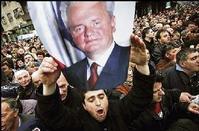
'Supporters holding pictures of Slobodan Milosevic shout as the vehicle bearing the body of former Serbian president arrives at his home town of Pozarevac, on Saturday. Tens of thousands of Serbs rallied to pay last respects to Slobodan Milosevic on Saturday, hailing as a hero the man who presided over years of bloodshed and was ousted by his own people. - REUTERS
JUSTICE
So, the fact that international justice could be meted out following civil strife may well cause warring protagonists to make sure that they win the battle.
Then they can seek to insulate themselves from arrest, trial and conviction. But this should not deter our thirst for justice. Warring protagonists can be expected to fight to the bitter end. Whether or not they will be liable for prosecution later on. Thus, removing the possibility of punishment will, in most cases, have little impact on the bitterness of the struggle.
Another development that could undermine justice is, perhaps paradoxically, reliance on truth commissions.
The most celebrated commission is, of course, the South African Truth and Reconciliation Commission, and indications are that this body has helped to reduce the potential for civil explosion in that country.
But spare a thought for the other perspective: Many of the foot-soldiers of apartheid may have escaped punishment for years of oppression by confessing their sins. We are entitled to be ambivalent about this result - at very least.
Slobodan has checked out. He has denied closure for putative victims of his reign. He has left us with the mystery of his death: poison, self-poison, or some other cause? He has left a very high bill for expenses to bring him to justice.
And he has left the world with uncertainty about what his final punishment would have been, if anything. But his trial has also left us with the knowledge that some dictators can be brought to justice.
Stephen Vasciannie is a professor at the University of the West Indies and a deputy solicitor general.