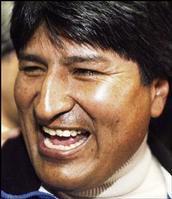
Recently-elected Bolivian President Evo Morales. - REUTERS
SAO PAULO, Brazil (AP):
DEEP UNDER the earth in Bolivia lies enough natural gas to supply South American consumers and industry for years, a windfall that could ease the astonishing poverty in one of the continent's poorest countries.
That is, if these barely tapped subterranean riches ever make it out of the ground.
With the election of the coca-growing street activist Evo Morales as the Andean nation's first Amerindian president, the prospect of Bolivia profiting from South America's second largest natural gas reserves after Venezuela is more unclear than ever.
The problem: Morales is trumpeting a vague plan to "nationalise" a gas exploration and production industry dominated by foreign companies, but Bolivia does not have the cash or expertise to take over the job, Latin American experts and oil analysts say.
CASTRO'S REGIME
Now everyone from petroleum company executives to countries like Brazil and Argentina that use huge quantities of Bolivian gas are analysing every word Morales utters as he prepares for his inauguration in January.
They're wondering just what nationalisation will mean for a president-elect who admires Fidel Castro's communist regime and blames unfettered capitalism for the deep poverty that Bolivia's majority Amerindians have lived under for nearly two centuries since the nation gained liberty from Spain. The country's gross domestic product was US$22.3 billion in 2004, about the same as Afghanistan and Angola.
Morales said last week that there will be no seizures of assets of
the big oil companies who have invested US$3.5 billion in Bolivia: Brazil's Petroleo Brasileiro SA, Britain's BG Group PLC, France's Total SA and the Spanish-Argentine Repsol YPF SA. He also suggested this week that Bolivia will "strengthen our relations with state oil companies and welcome and value their proposals."
But he also says the nation's gas reserves have been "looted", and insists that current gas production contracts are illegal and must be re-negotiated.
"There's a big feeling among Bolivians that these natural resources should be placed in the hands of the Bolivian state," Morales told reporters.
FORCED TO FIND A WAY
The outlook is expected to remain murky until Morales takes office January 22. But analysts believe Morales will be forced to find a way to work with the foreign companies - and quickly, if he wants to reap more natural gas revenue and pass it on to the poor.
Bolivia's recent political instability looms large over its problems harnessing the gas. Just two years ago, President Gonzalo Sanchez de Lozada was ousted in an uprising that killed 60 people over a government plan to export the gas via Chile, and from there to California and northern Mexico.
REBELLION LEADER
Morales was one of the rebellion's leaders, backed by millions of poor Bolivian Indians still seething over a 19th century war with Chile that left Bolivia landlocked.
This kind of volatility makes investors cringe in fear that potentially huge returns could evaporate at any moment.
"You don't want to put money into a place if it's going to be gobbled up by change in the regime or change in the laws," said William Edwards, a Houston, Texas-based oil industry consultant with experience in South America. "If Morales wants any chance for foreign investment, he has to change his tune."