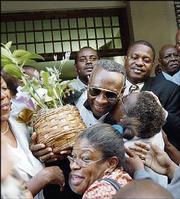
"LEFT": Supporters of Senior Superintendent of Police Reneto Adams surround him outside the Supreme Court in downtown Kingston, after he was acquitted of murder in the Kraal trial on December 20. - RUDOLPH BROWN/CHIEF PHOTOGRAPHER.
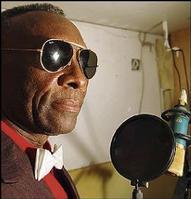
"RIGHT": SSP Reneto Adams in the studio. The policeman last week released a single 'To Protect And Serve'. - WWW.AFFLICTEDYARD.COM
This is the second and final instalment of an interview by Senior Gleaner Writer Earl Moxam with Senior Superintendent of Police Reneto Adams. The first part was published on Sunday.
Earl Moxam: It's one thing to respond promptly, but the question is, how you operate when you come upon that crime scene. How do you control your own emotions and the emotions of your men?
Reneto Adams: If I lead 50 men to a location, obviously we are acting on intelligence, bearing in mind the geography and culture of the community.
We have communities in Jamaica where as you enter as a policeman you are fired upon without any notice or without any of us transgressing against the rights and privileges of anyone in that community.
So, I find it a joy to go and look for the hardened criminal; men who fire M-16 rifles and AK-47s. And, therefore, in circumstances like those, it is likely that 90 per cent of the time you will be fired on. I cannot run away.
My men and I cannot retreat, and I certainly am not preparing myself to retreat from any criminal.
So, therefore, I, being of that attitude, if criminals start firing at me. I have no action to take other that to immediately fire back and defend the country against them.
So you find that, in circumstances like these, criminals are cut down and the remorse should be that they should have learnt before that, having taken up weapons against a law officer, the return action would be decisive and probably final, in some instances.
EM: Can you look me in the face now and tell me that the young men in Braeton got a fair chance?
RA: You know that the policemen charged in that case were acquitted. I told you from day one, and I've always said to this country ... what took place ...
I was surprised when the prosecution came and actually repeated verbatim what I had reported in the first instance. I thought that they had a case!
But, to answer your question as to whether they had a chance, yes. When I went (to the house in Braeton) I said to them, "I'm Senior Superintendent Reneto Adams. I'm here to execute a warrant on a particular individual. Come out! And instead of coming out, we heard gunshots being fired from the house at us.
EM: Did you give them any assurance that they would not be harmed if they surrendered?
RA: Well, at the time there was no indication from them that would allow me to say to them, 'if you came out you would not be hurt,' because after three minutes had elapsed, they started firing.
Policemen in Jamaica are trained in many ways, but the strongest way we are trained is that when you are fired on, immediately you have to defend yourself, the people and the country.
And, I would like to tell you that justice was served in all the circumstances of Braeton.
EM: Given your own illustrations of collateral damage, would you say there was collateral damage during the Tivoli confrontation?
RA: Yes. I gave evidence at the inquiry into that matter to that effect, about people voluntarily walking along with these criminal elements protecting them, thinking that that would have demotivated the police from taking the necessary action.
People were firing from all angles and, therefore, policemen had to respond. Remember, a soldier was killed and policeman was killed right beside me.
Another policeman was shot and seriously injured, and even today policemen are suffering the trauma of that incident. I counted about 75 men with rifles decisively taking the fight to the policemen.
EM: So, why did so many old, infirmed people die during that confrontation?
RA: That's a very good question. You know of that community being filled with only the old and infirmed?
EM: No.
RA: So, how did the old and infirmed appear so much in great abundance? I have my intelligence on that ... that they were deliberately taken out from their homes, from in the market, from in the street by these gunmen and put there to defend them.
These people did not want to do it, I'm quite sure, but they were forced. They were used as a shield!
EM: How much regret do you have about those deaths, bearing in mind that you are cognisant that they might have been innocent and might have been used by others?
RA: The regret is enormous, of course. If one man or one woman loses his or her life innocently, or even if the person is not innocent, it is something to cause some remorse. And I totally regret that that happened.
But when I go out on duty I do not go as Reneto Adams. I do not act personally. I act as an agent of the state.
It's like the hangman. If he carried out an execution at 5:30 this morning, he would have done it within the dictates of the law and not personally.
I acted as an agent of the state and continue to act as an agent of the state, so I do not personalise these things.
If I had gone out wilfully as criminals do and people ended up dead, then yes, your conscience would be so hot that it would literally burn you. But, not at all, I have no regrets where the criminal elements are concerned.
EM: Regarding the incident at Kraal, were you actually on the scene from the beginning when the shooting went down?
RA: Yes. I was the man who led the operation to Kraal.
You see, what happened on the day in question is that I was in plain clothes, whereas most people know me as a man who is dressed in helmet, riot gear, bullet-proof vest and M-16 rifle, ready for battle.
But this wasn't the case on this occasion. I gave instructions, I received intelligence and the action that we took was authorised by me, consistent with my training, consistent with the intelligence we had and the warrants we had ...
I want to say to you bluntly, that if I am to return to the street, it will not be because of the interest of the force; it will not be because of the interest of the Government, or the private sector or a collective set of politicians.
It will be for the poor, humble, innocent, law-abiding, innocent Jamaican people who I am paid - handsomely, I must say - to protect against criminal elements.