
Inner city does its homework
Published: Saturday | November 28, 2009
Contributed
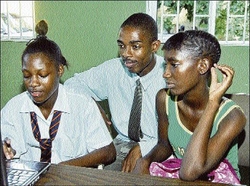
Coordinating Volunteer Huntley Anderson (centre) providing guidance for students Shawny Barnes (left) and Judene Rowe as part of the homework programme at the Women's Resource Outreach Centre on Beechwood Avenue in Kingston.
Nine-year-old Charlotte Rowe believes one of the biggest problems facing Jamaica today is HIV/AIDS. For her big sister, 14-year-old Judene, it's child abuse. Their friend, Michael Harper, who is a year older than Judene, feels it's the monstrous pangs of crime and violence and the Gully-Gaza feud among youth.
However, in spite of the serious threats that these issues present, Charlotte, Judene and Michael, who hail from inner-city communities in Kingston, have ambitious plans for the future.
"I want to be a veterinarian," Charlotte shares with a shy yet certain look on her small face. Deep-voiced Michael, who loves technical drawing and art, wants to become an architect or music producer, while Judene is yet to choose between a career in the army or education.
These bright youngsters are just some of the students, ranging from age seven to 18 years, who, for the past five years or so, meet four evenings each week to experience a different, positive, more productive side of life.
Willingly and happily
Under the guidance of a few volunteers, the youngsters willingly and happily gather to do homework, carry out research on the Internet, interact and learn social skills, courtesy of a homework programme established by the Women's Resource and Outreach Centre (WROC) on Beechwood Avenue in Kingston.
Set up in September 2005, the homework programme was a direct response to the needs expressed by parents of students in the Lyndhurst-Greenwich area who had just passed GSAT and would be starting high school. "Parents indicated that they lived in tenement yards that were noisy and crowded; there was no quiet place for children to do homework. Also, there was no one to assist them with their homework," explained Dorothy White, WROC executive director.
The core goal of the programme is, therefore, to help students to complete assignments. "Math, English, social studies, history - all the different subject areas - we do all of them," explained Huntley Anderson, coordinating volunteer and a full-time teacher at St George's College who has been involved with the programme for the past two and a half years.
The assistance programme is run from 3:30 to 4:30 p.m. "but sometimes students want to stay until 5:30", Anderson said.
Some "16 students attend regularly but on any given day we have 10-12 students" who are supervised by two volunteers. Students have access to computers, books, stationery and other resources to facilitate the completion of their schoolwork.
The programme also provides targeted support to students sitting their CXC exams and completing school-based assessments this academic year.
"In September, we did an assessment of the persons that are doing CXC. We know that they are weak in Math and English so we want to focus on those two core subjects so that they can develop those skills until they have exams in June," Anderson explained.
Apart from homework, there is also well-needed interaction among the youngsters.
"You find persons just want to come and talk and share," said the impassioned volunteer. Students are happy to meet and greet each evening, especially since most of them have been attending for several years. Indeed, participating in the homework programme is not only an academic exercise but also provides the opportunity to be a part of very closely knit group. Michael, Judene, Charlotte and their peers agree that they are "a family". They also share that "Anderson make us feel comfortable and smart, always helping to build our confidence."
Of course, this does not mean that students don't "give trouble" and have personal issues to grapple with. When students need special attention, they are referred to WROC's on-staff counsellor who sometimes requests that parents come in with their child for a counselling session.
Anderson explained that while it is generally difficult to contact parents, they do occasionally come in for the sessions. Parents from the community also tend to rely on the programme as a safe place to leave their kids when they are still at work.
Anderson, who is also studying, admits that going to WROC each evening after teaching a full day at George's "can be tiring" but stresses that he is committed to the students.
"When I finish in the evenings I might be drained, but I know that there is some form of appreciation, even while they give trouble. Just to see that the assignment is completed and they have a smile on their face you know that they have accomplished something for the evening, I feel good about that," he shared with a smile.
Whyte said she was pleased the programme was making a difference in people's lives.