
The arrival of the Germans (Part 2)
Published: Friday | October 2, 2009
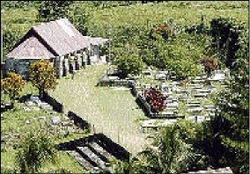
A view of the Seaford Town Catholic Church and the Cemetery. - File
The following is Part 2 of a republication of an article written by Dr Rebecca Tortello, as part of The Gleaner's 'Pieces of the Past' feature. Part 1 was published yesterday.
Seaford town
Seaford Town, named after Lord Seaford, is found in the Westmore-land hills some 25 miles from Montego Bay. The first set of immigrants to settle in Seaford Town arrived in the middle of December 1835. Some 250 men, women and children landed first in Rio Bueno, before going on to Reading and then walking inland to Seaford Town.
The original plan was that, on arrival, they would occupy cottages built for them and be paid small weekly allowances until they began to cultivate provisions successfully. Then they were to be given free titles to their lots. Instead, they had to build most of their own cottages and many were expected to work an average of 72 hours per week while subsisting on meagre rations such as 4lb of cornmeal, 1lb of beef, 4lb of flour and 3lb of salt fish.
Thirty-four of them died in the first two weeks. As stipulated in the Immigration Act, rations were supposed to include 10lb of cornmeal, 2lb of beef, 6lb of flour and 2lb of salt fish, with different wages given depending on the amount of food provided.
By the end of September 1838, the population had halved to 156 as a result of tropical diseases, overwork and some migration to America, based largely on the returns from sales of ginger.
To survive, these immigrants stuck together and learned how to plant banana, plantains, ginger, cocoa, coffee and cassava. During this period, apprenticeship ended and some ex-slaves moved into nearby areas.
Competitive relationship
A competitive relationship between them and the Germans grew, based largely on suspicion from both sides. This caused the Germans to band even more closely together. Soon, Germans released from other indentures began to arrive and a schoolmaster, Johnnes Bierbusse, emerged as his fellow immigrants' unofficial representative. A catechist also, Bierbusse could baptise, but he could not administer sacraments.
Many of the homes in Seaford Town were built with cellars, typical of architecture found in rural Germany. The town museum houses artefacts from early life in Seaford Town, such as pots, mortars and a wooden bathtub carved from the trunk of a tree. There is also a painting of the ship that is said to have brought the first settlers from Germany.
The first land titles were handed out in 1850 - three acres to each member of a household. The town's first priest arrived in the 1870s, when the population had grown to close to 500. An Austrian, Father Tauer, established a permanent mission and built a stone church. Destroyed by a hurricane in 1912, it has since been rebuilt.
Other German settlements
Seaford Town was not the only place Germans settled and so it is not the only place where light-eyed and blonde Jamaicans can be found. There is a German Town in Trelawny and, over the years, Germans were also found in Alexandria, Christiana, Brown's Town, Stewart Town and Ulster Spring. These communities seemed to have had greater contact with neighbouring towns than Seaford Town, which is probably why Seaford Town tends to be regarded as having the strongest German retentions and is thus often referred to as if it is the only German town. Indeed, the terms 'Seaford Town' and 'German Town' seem to be used interchangeably.
Of course, there are also places, often found in the island's hillier sections, whose names reflect German influence, such as Manhertz Gap, Charlottenburgh, Mount Holstein, Bremen Valley, New Brunswick and Hessen Castle, among others.
'Germaicans'
Today, some 160 people of German descent remain in Seaford Town, but family names like Dusterdick, Eisinger, Sleifer, Volker and Zwinkman, present 100 years ago, have disappeared. Inbreeding, along with some integration with Jamaicans of African and Asian descent, occurred, leading to the creation of 'Germaicans', as stated by one resident of Seaford Town.
Sources: Hall, D. Bounties European Immigration with Special Reference of the German Settlement at Seaford Town, Parts 1 and 2. Jamaica Journal, 8, (4), 48-54 and 9 (1), 2-9. The Gleaner. Seaford Town Advertising Feature. August 14, 2003, D7-8, Jacobs, H.P. (2003). Germany in Jamaica. A Tapestry of Jamaica The Best of Skywritings. Oxford: Macmillan Caribbean and Kingston:Creative Communications Ltd. p. 362-363. Levy, M.C. Through European Eyes: Jamaica 200 years ago. Jamaica Journal, 17, 4. p. 32-42. Photos courtesy of HEART/NTA Communications Unit.