
FirstCaribbean to clip lending rate - Bank cuts will stimulate investment, consumption, says BOJ
Published: Wednesday | September 30, 2009

The Liguanea branch of FirstCaribbean Jamaica. The bank will cut its prime lending rate to 20.25 per cent on October 1.
FirstCaribbean International Bank Jamaica Limited (FCIBJ) said that it would clip 150 basis points off its prime lending rates, accepting the cue from the central bank which has already cut signal rates five times this year.
FCIBJ's prime rate will at October 1 adjust from 21.75 per cent to 20.25 per cent.
It is the second of seven commercial banks to cut, following Scotia-bank's one-point adjustment of its base rate in August to 20.5 per cent.
At the time it matched the Bank of Jamaica's adjusted rate on its benchmark six-month Certificate of Deposit, but since then the central bank has cut rates again with the benchmark instrument now priced at 17 per cent.
Interest rates adjustments
FCIBJ said the cut in its prime rate follows previous adjustments in June on interest rates applied to auto loans and general purpose loans "in line with the industry".
FCIBJ is fourth largest of the seven banks whose combined assets total more than half a trillion dollars.
Several local banks have said that they are considering a cut in lending rates. National Commercial Bank says its current base lending rate of 21.75 per cent is negotiable, while First Global Bank says its 20.75 per cent rate is under review.
Bank of Jamaica (BOJ) has shaved a cumulative 4.5 per cent off benchmark rates since July.
"Lower domestic interest rates make borrowing relatively more attractive than savings in domestic instruments (that is, deposits etc)," said the central bank.
"In this context, households will increase expenditure, particularly on durables, while businesses would have a greater incentive to expand or retool, as financing costs will be lower. The increased in expenditure would provide some impetus to economic activity."
BOJ said its 4.5 percentage point cut in rates since July should impact what banks charge for loans, given that as deposit-taking institutions they invest the deposits of their customers in a range of investments, including Government bonds.
Incentive to lend
"The interest rates on the bonds are positively influenced by the rate on BOJ's open market instruments (OMO). The higher the rates on BOJ's OMO, the greater the incentive for banks to invest in bonds as against extending loans or engage in other investments," said the BOJ.
"Given the opportunity cost, banks will therefore set lending rates at least as high as the rate of return it receives on other investments - such as the BOJ's OMO. BOJ rate cuts therefore provide an incentive for banks to lower their lending rates."
The central bank adds that when monetary policy rates are reduced, it also reduces banks' incentive to hold central bank assets, thereby increasing liquidity in the system.
"This increases the volume of funds available for lending by the commercial banks, thereby exerting downward pressure on loan rates."
The central bank said that OMO rates would also influence the rate of return banks provide on various deposits and other products they offer to customers.
"These interest rates comprise a significant component of the cost to the banks for mobilising funds. Given the bank's desired interest rate spread (which determines profitability), lower OMO rates would influence a fall in lending rates, through a reduction in the cost of funds."
The central bank noted, however, that the pace of reduction loan rates to a monetary policy adjustment is also influenced by the maturity structure of the banks' liabilities, given that these liabilities would have been incurred at higher interest rates.
"This helps to explain why interest rates tend to be 'sticky downwards'. In deciding on the structure of their lending rates, the banks would also take into account operational costs, returns on alternative investments and other factors - for example, risk, competition in the sector, demand for loans," the bank said.
avia.collinder@gleanerjm.com.
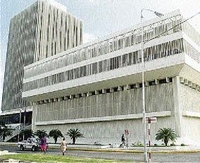
The Bank of Jamaica, on the waterfront in downtown Kingston. - File photos