
'Capitalising' on redundancy
Published: Monday | September 14, 2009

Dwight Taylor: "We are in this for the long haul."
Looking at the traffic rushing by on busy Wash-ington Boulevard from the first floor of his business, Dwight Taylor is quietly optimistic about the future.
Over a decade ago his position in the maintenance department of Air Jamaica was made redundant. It was one of the best things to happen in his life.
With a bit of cash at his disposal, he decided to go into business. "I was fortunate to partner with my father-in-law who already had a business up and running."
Jemar Printery, at the corner of Hendon Drive and Washington Boulevard, had originally been registered in 1983 by Calvin Jones and his wife Eula to service and maintain heavy equipment, but became dormant until 1994.
"It was re-started as a stationery business, but my father-in-law said we should take it into continuous form printing."
The business world is often viewed as a cut-throat environment, but for start-ups, the opposite is often the case. Printers can operate more effectively when they have collaborators who can share specific jobs, so Jemar found a supportive environment.
"We knew people with the expertise who could guide us," said Taylor. "We also knew people who were willing to give us an opportunity to provide our services to them. That is how we got our start."
It was a big help that co-founder Calvin Jones had extensive business experience, and Eula, also a director, had an extensive background in administration and finance.
The company began with offset printing, which is the most common form of high-volume commercial printing. This is due to its advantages in quality and efficiency for high-volume jobs.
They began producing office stationery, letterheads, business cards and other jobs where long print runs are useful.
Digital printing
Moving next into digital printing was a good fit. With much of the initial set-up computerised, it is generally quick and cost effective for small print runs, offering a means of providing a more diversified service from the offset business.
"If you want 1,000 flyers, you can get it in 20 minutes," he said of the digital service. "Printing from a high capacity laser printer can handle that volume."
Clients for the service vary from home-based graphic designers to corporate clients requiring proof prints of an annual.
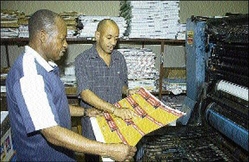
Dwight Taylor (right) in discussion with press operator David Stewart about the colours in a press run. - Contributed photos
The challenge here, is that desktop publishing has become commonplace as it is not a particularly expensive line of business to enter. A low barrier to entry limits both the size of the market and its profitability for individual printers.
This is where the printing of continuous business forms comes in. This leg of their business met their strategic objective of entering a market where they could carve out a secure niche with good prospects.
Used in speciality commercial and industrial markets, continuous forms consist of single or multiple sheets of paper, perforated at regular intervals so the sheets can be easily separated. The paper normally has holes punched along each side so that it can be pulled through the printer by a tractor-feed mechanism.
The market is limited to a number of large users, but the capital requirement means that Jemar only faces two other key competitors.
Needing a major loan on favourable terms to move into this sector, Taylor approached JN Small Business Loans (JNSBL), one of Jamaica's top lender to the small and micro enterprise (SME) sector.
"We provided him with a BizBoost loan," said JNSBL's General Manager Frank Whylie. "He was the first to access the facility."
Having laid out their business plan for the new operation, the Jemar management had thoroughly researched their requirements.
"We were in the process of sourcing equipment, so we knew what we wanted," Taylor said. But they first had to finalise the specifics of the acquisition.
The loan agreement was concluded in time for them to make their purchase, Taylor stated. That was two years ago.
The loan was to purchase machinery as well as raw material, Whylie said. Acquisition of the continuous printing machine allowed Jemar to retool and efficiently develop the new line of business.
"The continuous forms business is now our biggest growth area," Taylor said. It is also their main source of income.
High level of competition
There are so many printeries in Jamaica that there is generally a very high level of competition in the sector. To keep their customers satisfied, Taylor said they worked hard to keep their service and product quality high.
One secret in the industry is for printers to offer customers advice on adjusting their requirements so their printed materials can have a strong visual impact at a lower price.
Changes implemented from last year to cut energy use and improve equipment servicing have also borne fruit. He said, "We stepped up our game to make the savings."
Business was slow at the start of the year, but since then, he said, "it has improved substantially."
The low-interest loan from JN Small Business Loans which opened the way for the new and more profitable line of business is also a major plus.
"We are in this for the long haul," the printer stated. "This business has good prospects."