
ODPEM programme bears fruit
Published: Saturday | August 29, 2009
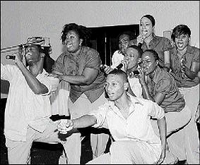
Dance group Ashe performs as the Office of Department and Emergency Management launches its national hazard awareness and safe-building campaign at The Jamaica Pegasus in St Andrew yesterday. - Norman Grindley/Chief Photographer
Precisely one year to the day after Tropical Storm Gustav unleashed its fury on Jamaica, there are signs that a new wind is blowing in the right direction.
Signs are emerging that an initiative to promote the building of safer houses across Jamaica, particularly in traditionally vulnerable areas, has started to yield positive results.
The Office of Disaster Preparedness and Emergency Management (ODPEM) yesterday unveiled the public-education segment of an ambitious $60-million initiative, which promotes safe building practices.
There are early indications that the benefits to be derived from the programme will outstrip the expenditure in value.
changed fortunes
The project has already changed the fortunes of hundreds of Jamaicans in the eastern end of the island, which was ravaged by the storm.
It is geared at resocialising Jamaicans in housing construction, while lending a helping hand to those dislocated by Gustav.
It was Jamaica's Prime Minister Bruce Golding who, last year, approached Britain's Prime Minister Gordon Brown on the urgent necessity to resocialise Jamaicans on how important it is to build their houses to withstand the wrath of nature.
The British prime minister loved the idea, got his government to pump the funds into the project and today, hundreds of Jamaicans have benefited under the programme.
If the words of director general of the ODPEM Ronald Jackson and his project manager, Kirk Frankson, are anything to go by, the project is yielding great success.
Jackson revealed that of the 4,000 Jamaican households which were affected by Gustav, 2,000 persons were left homeless or experienced severe damage to their houses.
severely hit
He said 1,500 homes in the four parishes in the eastern end of the island, which were most severely hit by the storm, had so far benefited under the initiative.
"We have retrofitted over 600 of the 1,500 houses in St Mary and we are about to roll out in Kingston," he disclosed.
With one of the partners, the HEART Trust/NTA lending its expertise, Jackson said 200 persons had so far been trained.
He said that the issue of technique was important, as well as the design of houses and the simple method of utilising straps, among other things.
Frankson, the ODPEM front man in the communities, characterised the project as interactive as it seeks to assist those displaced while engaging others in the transfer of knowledge.
He said his team was imparting the principle of natural resistance and successful mitigation by empowering Jamaicans to take action through preparedness.
Deputy British Commissioner Graham Glover says all too often when natural disasters strike, it is the poor and vulnerable who are most severely affected.
gary.spaulding@gleanerjm.com