
Filing a hardship waiver
Published: Tuesday | July 14, 2009

I am married to a US citizen and I have two children who were born here. I entered the US without inspection in 2002, filed my papers but was denied due to the fact I had no I-94.
I had a lawyer but must say she started me wrong. I went to court and I opted to leave on my own, so I want to know where do I go from here.
My lawyer said she was going to file a hardship waiver. she said by the time I get to Jamaica the papers should be at the Embassy there.
I need to know if that's an option or should my husband just refile. My children are three and one; one has a medical condition that she is being treated for here in the US. I should be in Jamaica shortly so I need to know what to do.
- MM
Any person who files to adjust their status in the United States from non-immigrant to immigrant (Green Card holder) after May 1, 2001, must have entered the United States after being legally inspected. This means that a person must have entered the US with their own passport and visa (if applicable) and be inspected by a Customs and Border Protection officer (CBP). Once you are legally inspected you would receive an I-94 landing card in your name.
If a person walked across the US border, entered the country by boat, without seeing a CBP officer, entered the US in someone else's name, or entered on a photo-switch passport, they cannot adjust their status in the United States. Section 245(i) of the immigration law was repealed, effective April 30, 2001. This section of the law allowed persons listed in the above categories to pay the US government a penalty fee and remain in the United States, and change their status. With the repeal of the law, persons who entered without inspection must leave in order to obtain their Green Cards.
The catch is that if you were out of status (overstayed) in the United States for six months to a year, once you leave the United States, you face a mandatory three-year bar to returning to the United States. If you overstayed for one year or more, the mandatory bar is 10 years. The only way for you to overcome the mandatory bar is to be granted a hardship waiver by the United States Citizenship and Immigration Services (USCIS) field office in Kingston.
Placed in deportation
It appears, from your question, that once your Green Card was denied you were placed in deportation - hence your appearance before a judge. Leaving is not an option. If you are ordered removed you must leave, especially if your lawyer requested voluntary departure. Failure to leave makes you an immigration fugitive, subject to detention without any further court appearances.
Depending on when your husband filed to adjust your status, you may be able to continue that petition by requesting USCIS transfer your case to the National Visa Center for consular processing. Once that is done you will have to complete the process as if you were filed for while living in Jamaica. If that is not possible, then your husband would have to start the filing process for you, from the beginning. When you are interviewed at the US Embassy for the Green Card, you will be denied - because of the overstay. Also, depending on how you entered the United States, that may also be held against you, i.e. if you committed fraud in your entry.
Extreme hardship
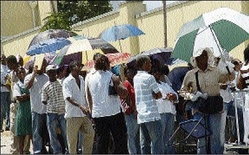
Jamaicans who wish to visit the United States outside the embassy in this 2007 file photograph. - file
Once you are denied at the US Embassy, they will advise you if you qualify to apply for a waiver. It will actually be your husband who will apply for the waiver and the one who will have to demonstrate extreme hardship in order for you to return to the United States. It is unfortunate that you have an ill child. however, this fact will be helpful towards your return. The hardships your family is experiencing must be well articulated and documented in order for the waiver to be granted. It cannot be general hardships - i.e. that you miss your family and your family misses you, or that your husband is having a hard time handling the children in your absence.
While you are out to try to return to the United States, yourself and your husband should have a plan B just in the event that your waiver is not granted. The processing of the waiver can take up to a year before a decision is made.
Dahlia A. Walker-Huntington, Esq. is a Jamaican-American attorney who practises law in Florida in the areas of immigration, family, corporate and personal injury law. She is a mediator, arbitrator and special magistrate in Broward County, Florida. Send questions and comments to info@walkerhuntington.com or editor@gleanerjm.com