
New simulator to better bus driver training
Published: Saturday | May 16, 2009
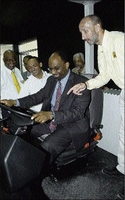
Jamaica Automobile Association (JAA) board member Earl Jarrett (seated) is guided in handling the controls of a bus driving simulator at the Caribbean Maritime Institute (CMI) in Kingston, in mid-April, by Alan Beckford, JAA general manager. Looking on (from left) are Fritz Pinnock, CMI executive director; Dr. Lucien Jones, National Road Safety Council vice-chairman; Derrick McLennon, CMI lecturer; and Rafael Luis Cil Oviedo, CMI senior lecturer. – Contributed
THE QUALITY of Jamaica's public transport sector drivers is set to improve with the acquisition of a bus-driving simulator by the Caribbean Maritime Institute (CMI), says Fritz Pinnock, CMI executive director, during a recent visit of the National Road Safety Council (NRSC) to the facility.
The result of a joint project between the Governments of Belgium and Jamaica, the simulator will form the basis for launching a new public transport driver-testing course, Pinnock said.
Located at the CMI campus at Palisadoes Park in Kingston, it represents a major advance in local driver training. "It provides simulations of actual Jamaican bus routes," Mr Pinnock said.
The designers were so detailed that they included the potholes on the bus routes.
good training aid
The system should help drivers improve their handling of buses in traffic, in terminals and under several other operating conditions. Mr Pinnock said the system was one of only three in the hemisphere.
"The simulator controls and layout have the appearance of those in a real Jamaican bus," said Jamaica Automobile Association (JAA) board member Earl Jarrett. The JAA is a member of the NRSC, of which he is also co-chairman.
"Allowing drivers to test their skills in a controlled environment, off actual roads, provides a good training aid," Jarrett said. Experience with the safety programmes at the Jamaica Automobile Association (JAA), a subsidiary of JNBS, was that some of the major problems on the roads were caused by inadequate driving skills.
Rather than training in a vehicle, with the attendant costs and risks, the simulator is a good mechanism for identifying good drivers and helping others identify their flaws, said Dr Lucien Jones, NRSC vice-chairman. With all the basic components found in late-model transit buses, the simulator also provides an effective measure of the comparative driver-skill levels.
benefits and expectations
The system is expected to lower training costs, lower failure rates among new employees, reduce collision rates and improve road safety, Mr Pinnock stated.
The simulator will first be integrated into the JUTC driver-training programme before being applied in other sectors. The JUTC already has a focus on accident reduction, with Desmond Creary, senior vice-president of operations, reporting a fall in 2007, following on earlier declines, due to improvements in monitoring and defensive driving.
Costing €1 million (J$115 million), the simulator was designed and constructed by Transurb-Technirail, the Belgian company responsible for the design of the Half-Way Tree Transport Centre.
The simulator is housed at CMI as it has experience managing other types of simulators, Mr Pinnock stated. The Institute is reshaping itself to serve the needs of the transportation sector, rather than restricting itself to a maritime focus.
"We are currently developing a ground transportation management degree programme," the CMI executive director said. "We will train people right up to that level."
Others participating in the simulator demonstration included Alan Beckford, general manager of the JAA; Victor Anderson, coordinator of the NRSC Save 300 Lives Project; Vivette Grant, CMI deputy executive eirector; Captain Rafael Luis Cil Oviedo, CMI senior lecturer; Paula Fletcher, NRSC executive director; and Derrick McLennon, CMI lecturer.