
Live Well with Eulalee Thompson
Published: Monday | December 29, 2008
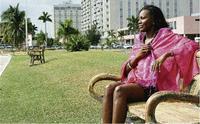
Author of 'Live Well', Eulalee Thompson, relaxes by the waterfront in downtown Kingston. - Norman Grindley/acting Photography editor
She usually saunters into The Gleaner's Editorial Department, hair neat and Jackie O-type shades in place. This, after climbing four flights of stairs; no easy elevator ride for our multi-award-winning health editor. She practises what she preaches.
She is precise in her actions and proper in her demeanour, sometimes a tad stern on colleagues who just don't get it or didn't do something her way, but she is a pro, and after years of perfecting the newspaper's excellent weekly Health section, it's not surprising that a book is the result.
Titled Living Well, it is a compilation of health and wellness articles covering topics such as Chinese medicine and the virtues of coconut oil. Lifestyle Editor Barbara Ellington spoke with the new author in an email interview.
How long have you been a journalist and why the focus on health and wellness?
Looking back, I realise that journalism has been a journey - 20 years. It has been 20 years of hard work, challenges, but, by and large, 20 years of triumph.
In 1988, then Gleaner Editor-in-Chief Dudley Stokes threw me into the deep end as a rookie, making me coordinator for the Youth feature, two broadsheets of The Gleaner ... the forerunner, if you like, of the current expanded youth product.
I actually first set foot in The Gleaner in 1987, while a final-year student at the University of the West Indies. Stokes had put out an advertisement for new columnists, I thought I could fit the bill. I wrote a column about the death of Peter Tosh. I was always a Tosh fan; he appeals to that side of me which is a rebel (people who know me well know that side). The editor liked the article, he invited me in for a meeting but explained that I was too young to be a columnist. I was still a university student and I was offered a few hours on Mondays to do assignments, rewrite press releases and do the Youth feature. I didn't turn it down.
Why focus on health and wellness?
I can't say it was planned. I started out as a general reporter but I soon got tired of covering lunches, dinners and breakfasts - we did many of those then - and reporting speeches. I had several sojourns from The Gleaner either to do postgraduate studies or work in other areas of journalism ... . One of my sojourns was to Inter Press Service 1990 to 1993 ... . It was a wire service. I did a lot of travelling and overseas assignments. One of my assignments was to live and work in Zimbabwe, then my reportage changed. It was more developmental kind of reporting, more in-depth more meaningful. Health and environmental reporting was big in developmental journalism. When I got tired of living out of a suitcase, I came back to The Gleaner in 1993. Wyvolyn Gager was, I think, associate editor at the time (soon editor-in-chief).
As I said in the introduction to the book, Live Well, she was the one who casually mentioned to me in the first or second week that I came back that she always had an idea to start a health feature in The Gleaner. She didn't have to tell me a second time. I ran with it. I found my niche ... . I am forever in her debt.
Over the years, you have won enormous respect from your peers as well as experts in the field, both regionally and internationally. Can you say which award gave you most satisfaction?
I have won over 30 awards (I have stopped counting) from Pan American Health Organisation, World Health Organisation, Press Association of Jamaica, Medical Association of Jamaica, UNFPA, The Sandals Group (for environmental health writing), WELLPRO/Environmental Health Foundation, UNDCP, Blue Cross of Jamaica, and more.
I would say that I received great satisfaction from all of them, but if I had to single out any, it would be the Pan American Health Organisation/World Health Organisation Special awards: The Sagicor Award for the series 'Battle of the Bulge', September 2006. It involved teamwork and readers; it was also interactional journalism and it was highly transformational. It allowed me to apply the principles that I learnt in psychology to journalism to effect behaviour change. It was really a gratifying piece of work.
It was teamwork with Dr Wendel Abel, conceptualising a series where we worked with real readers over a period of time who had weight challenges. It evolved out of Editor-in-Chief Garfield Grandison's idea in 2005 to have a year in health and I am also in his debt, he always supported health journalism and Your Health andgive me the space to be me. We have to acknowledge The Gleaner and Managing Director Oliver Clarke for continuing to support health as a clear specialty in journalism.
Other team members and professionals in nutrition, Rosalee Brown; Dr Suzanne Soares-Wynter, weight measurement (TMRI, UWI); and Dr Kenneth Gardner, exercise; colleague reporter Trudy Simpson worked with us in this process, counselling the participants, following them up and recording their history. So many readers followed that series and made lifestyle changes based on the expert advice given to the participants. We did, in fact, see dramatic changes in waist circumferences and fat deposits in the participants at the end of the challenge.
We weren't working for an award but we are glad that we got one.
Do you ever consider making the transition from journalism to medicine?
No, never ... but I am asked that a lot. Ironically, I did the sciences all the way to sixth form at my alma mater, Immaculate Conception High School, and was in that select group destined for medicine ... . I can't recall how I was allowed to drop the sciences and take on the arts in upper sixth form. I continued the sciences and the arts at university, loved it and was so comfortable.
In a way, I have come back around to the sciences as I now practise in counselling and therapy having continued graduate training in this area ... but I have no regrets ... never regretted not pursuing medicine. It would have probably brought me more money but surely not more happiness and I am happy.
If I had done medicine, I know I would have done psychiatry anyway, because therapy was my thing even before journalism found me.
How do you assess the amount and quality of health reporting in Jamaica?
Easy. Not enough health reporting and the little being done carries little depth and understanding of the real issues.
Health has its own language and ethos. In the early days, I worked in the trenches, going to most of the health conferences on weekends, doing lots of one-on-one interviewing with doctors and other health professionals, building knowledge and working my way on the learning curve, learning the jargon ... . It's the kind of beat that you can't just get by ... . You have to be willing to get into the tough health reports, journalists, etc, and think.
Did you always want to be an author and will this be the first of many books?
Always at the back of my mind was that some day I would compile some of my health articles, especially since so many readers were already clipping them and keeping them, using them in schools, etc.
But I actually thought my first book would have been a publication of my poems. I have been writing poems since I was a teenager and never had the courage to publish them. I am happy to say that I found the courage to publish one of my poems, 'My Safe Place', at the beginning of Live Well. Who knows? Maybe I will come out with the book of poetry soon. I definitely have other books up my sleeve.
Describe the process of putting the project together and tell us who are you targeting with the book.
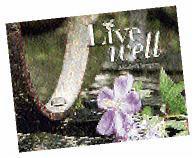
As you can imagine, after 20 years of writing, the original manuscript was massive, just huge. Compiling the manuscript was a chore. I carried it around for a while, rereading it, taking advice from friends and colleagues in publishing, health, journalism and just anyone who would listen. I decided after a year or so to make the manuscript smaller and place the articles into themes. The original manuscript is still intact but this first book is more of a coffee-table style book, with lovely photography of Milling Spring, Gordon Town, and its focus is on wellness.
Live Well is meant to empower readers to take charge of their health. Our health is really our responsibility - eat well, rest, exercise, take care of our mental well-being and build a support structure of genuine friends.
The language is accessible, the photography is pleasing to eyes and readers have been telling me that they feel relaxed when they look at the pictures of the flowers and waterfalls in the book. My target is really everyone, young and old, interested in adopting and preserving better lifestyles. The message is Live Well 2008 and beyond.
Does becoming an author represent the crowning moment of your career?
You know, Barbara, I feel that my life is one that is forever evolving and so I don't see becoming an author as a moment in my life, but rather I see it as a distillation of my thinking, of my work, and of my life at this point in time. As my life unfolds and evolves, I look forward to other expressions of this, my life.
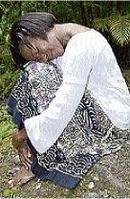
Eulalee Thompson