
Gomes, JFJ in spotlight
Published: Sunday | December 28, 2008
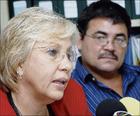
File
Dr Carolyn Gomes (left), executive director of Jamaicans For Justice (JFJ), addressing members of the media during a briefing. Looking on is David Wong-Ken, a member of the JFJ.
The following is an extract of an interview with Dr Carolyn Gomes, executive director of Jamaicans for Justice and recipient of the United Nations Human Rights Award, conducted by Robin Lim Lumsden.
RL: Carolyn, you were awarded the prestigious United Nations Human Rights Award on December 16. You are in stellar company: Dr Martin Luther King, Nelson Mandela. Tell us a little about your experience at the UN.
CG: It was all very surreal, from the time I got the phone call and it just stayed surreal and really strange until I got there. On the day itself they called and asked me to be part of a panel discussion celebrating the 60th anniversary of the Declaration of Human Rights, and the lessons learnt. They called me on the Monday and the ceremony was on the Wednesday and I thought, 'I can do that; I've been in panel discussions before'. When I got there I realised it was in front of the entire assembly. I was terrified, especially as all I had were a few notes scribbled on a piece of paper and they wanted a copy of my presentation for the translators. I told the Assembly that I was terrified and that I had never done this before, but I would share with them what I thought were the lessons from Jamaica.
Did you have a hint the award was coming?
I really didn't. I remember being told that I was being nominated for something by (Justice Minister) Dorothy Lightbourne. Mrs Palmer (the permament secretary) asked me to send in my CV; but that was months ago maybe in January or February of this year. So when the phone call came I was literally rendered speechless (laughter) my family don't recognise me - speechless.
Did you get to talk to Dr Denis Mukwege, one of other awardees?
Yes. He was awesome, a gentle, giant of a man from the Democratic Republic of the Congo. He is a surgeon and obstetrician/ gynaecologist who has spent his life providing reconstructive surgery for women who have been victims of war; he has called the rape, as conducted in the DRC, a weapon of war. He is a big man, but you just got waves of gentleness from him. He accepted the award on behalf of the women and to be the voice for the women and to call attention to this genocidal practice.
What does winning this award mean to you and Jamaicans For Justice?
I hope that this award shines the spotlight on the abuses that are occurring in Jamaica; that it helps to bring an end to the impunity of the state abuse of rights, which has been an actual practice for hundreds of years, but particularly in the area of police killings, the last 30 years have been very sad. I hope it brings a little legitimacy to the work. There are many across the island who don't understand JFJ's work and choose to distance themselves from human rights. I hope it brings an understanding that we cannot move forward with our development without a focus on human rights issues.
You have been involved with human rights work now for about 10 years. Why do you do this work?
Sometimes I feel I should have thought about it a bit more deeply. (laughter) I'm sure my children think I should have. Part of it was my family ethos - you don't accept the way things are; you work to change them; and there is the service ethos. My parents were products of the University of the West Indies and the Federation, Independence and the anti-colonial movement that thought everyone was equal; that was their background. There is on file a picture of me at age 21, protesting in front of the general hospital in Port-of-Spain with placards saying we need medicine to treat patients properly, so obviously something was stirring.
In a country where 'dem fi dead' is part of our culture, does it bother you that so many people don't understand what you are doing?
It surprised me at lot in the beginning. When you do enough reading on human rights you get to understand that this view is notlimited to Jamaica. Studies have been done across the world and the majority of people just want to feel safe and they just want somebody to do something about the crime and they are really not looking too hard about what people are doing. As a consequence, in high-crime situations, often there is a cry for the criminals to be dealt with. It is the response in Nigeria, Brazil, South Africa and some of the newly emerging democracies in Eastern Europe. Very often, the law enforcement apparatus is not in shape to do it on the basis of protecting human rights. They don't have the understanding or the capabilities to do it, so quite often you get into this pattern of state abuse, where there are high levels of crime
Are human rights a luxury Jamaica cannot afford?
Until we put human rights at the centre, we will never have a handle on crime. They are the basis for which we fight crime, because of the abuse of the rights of the victims. We are not going to get anywhere if we leave out human rights; what we end up doing is breeding crime.
Explain what is meant by the indivisibility of rights.
First, there is the concept hat all human beings are born equal in dignity and rights. All rights are indivisible and cannot be separated from a human being; further, all rights are also interrelated, so your right to vote cannot be separated from your right to freedom of expression and association, which cannot be separated from your right to an education.
Do you and JFJ 'hug up' criminals?
One of the questions asked at the UN's Awards ceremony by a journalist, of Ramsey Clark (former US attorney general and internationally renowned human rights defender), was why he had defended all these evil people. It is interesting to see the ignorance carry forward, because it is about everybody's rights and the minute you begin to say that one doesn't deserve human rights or that you need to give up some rights, it's the minute you begin on that slippery slope to anarchy towards a society in chaos, as we are now. So no, we defend people's rights; their right to a fair trial to be treated equally, and the place where the determination is made is in the courts in front of a fair trial with evidence brought forward, not anywhere else.
What do you think are the most important steps the Jamaican Government needs to take to improve the administration of justice?
We have to reform the police force. We cannot continue to accept the low standard and the corruption. We have a template and we have the strategic review and we have to continue to work on that in a systematic way. We have to be doing the Justice Reform Task Force reform and we need to set out for the people what we are going to achieve.
We have to close down the 'the crime factories'; simultaneously, we need the commitment to social interventions to change the circumstances that result in so many of our people believing that there is no other way, or choosing the way of criminality and the culture of drugs and gangs. We didn't get here overnight. This is a 10-20- year process.
What initiatives does JFJ support?
The establishment of an independent commission to investigate cases of state abuse and the reform of the Office of the DPP. It is absolutely necessary and something for which we have been calling for a very long time. Also, increasing the number of judges and the introduction of real-time reporting to clear the backlog is critical.
If you could do one thing to change the justice system what would you do?
I would be to put a customer service desk right at the front of the courthouse. Open the court at 8:30 a.m. and have someone who says, "Good morning, how can I help you?" It would entirely change the way people feel about their role in the justice system. As it is now, we all bundle up on the steps of the court until they decide to open the door at 10 o'clock.
Should concepts of human rights be taught in school?
Yes, it is part of the work we do and it is interesting to listen to the children because they carry a lot of attitudes of their parents, but they're not as hardened. So you can dialogue with them and sometimes, if you are really lucky, you can get to see the scales dropping off their eyes.
JFJ has worked to protect the rights of children. Tell me a little about that work.
The work has centred on the abuse of children in the care of the State, because about 4,000 children have no other parent but the Jamaican government. It is so sad because we come with the attitude that these children should be grateful because they don't have anything, and this attitude is at the board level, and whatever we give them they should be grateful for it. What we are saying is that these children are of lesser value. This is not the entire system, but it is an attitude that pervades, and it has to change at the level of the Government.
What does JFJ do for victims of abuse?
I hope JFJ represents a place where they feel understood, less lonely in their anger, their hurt and sense of injustice, where we try to get the system to work for them instead of against them. Sometimes JFJ is just an outlet for outrage.
What is your personal view on the death penalty?
I don't approve of it; I don't give life, therefore, I am not in the business of taking life. I think it is the wrong thing for a government to send the signal that killing is wrong by killing in cold blood; I'm very strongly opposed to it. What we need is a fix for our crime. If we were to take all people on death row and hang them in the public square today, it wouldn't change the crime rate one iota.
Jamaica is a signatory to the Inter-American Commission on Human Rights. What would ratifying that treaty mean?
What it means is that decisions would be binding, and I think it is important to signal a willingness to be bound by international human right norms. I feel strongly we should sign and accept the jurisdiction of that court, especially as we have a lawyer on that court. Margaret Macaulay, who is a Jamaican judge on the Inter- American Court.
What breaks your heart?
Monica Williams's deep-seated hurt at the death of her 15-year-old son that manifests itself as anger. The police shot Jason when Monica was away; it is the most revolting story. She got a flight home the next day and she kept trying to ask what was wrong with him and they told her he was in hospital. She said that when they passed outside the gates of the Spanish Town Hospital and did not turn in was when she started to scream because she had known all the time he was dead.
What keeps you hopeful?
Monica (laughter) and her big son Leonard who is going to be a father, who gets on with living even though she has that big hole in her heart where her son [Jason] used to be, and her family who have nothing except each other, and they the love each other and perpetuate the best about being human. And the hundreds of 'Monicas' whom I have met.
When will you stop?
I don't know, the door opened and I walked though it. There are people who can take over and carry on the work at JFJ. I don't think I will ever give up doing human rights work. I may give up being executive director of JFJ, but human rights is now too deep in my bones and deep in my heart.