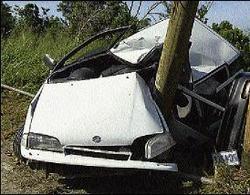
This Suzuki Swift motor car was seen wrapped around a utility pole along the Spur Tree Hill main road in Manchester. It was unclear whether there were any injuries as a result of the accident. - Ian Allen/Staff Photographer
TRAFFIC DEATHS are not confined to persons speeding in motor vehicles and breaking other rules of the road.
Pedestrians consistently represent a large share of crash fatalities, data from the Road Safety Unit of the Ministry of Transport and Works indicate.
Of the 275 traffic deaths as at November 13, 78 victims were pedestrians, 12 of them children. Twenty-five children were killed last year, 15 of them pedestrians. Ninety-one pedestrians were killed in 2007.
The Road Safety Unit expects pedestrian fatalities to decrease by 17 per cent at year-end below the 108 pedestrians killed on the roads last year.
However, Paula Fletcher, executive director of the National Road Safety Council, said that this may not be attained unless road users exercise due care on the streets.
Noting that 30 per cent of pedestrians killed on the roads are children, Fletcher urged parents and school administrators to protect children.
"Children do not have the mental and psychological make-up to make safe decisions in a changing, complex traffic environment," Fletcher said.
Ninety-five pedestrian children have been killed as a result of crashes.
Several elderly persons have also suffered this fate. In fact, 146 pedestrians above the age of 60 were killed on Jamaican roads in the last six years.
Meanwhile, studies have shown that there is a correla-tion between crashes that result in pedestrian casualties and wearing dark colours at night.
Studies show that motorists have less than one second reaction time to brake or swerve from pedestrians walking in dark-coloured clothing at night. Also, most people think that if they can see the headlights of a car approaching, the driver in that car can see them too. Studies also report that eight out of 10 drivers who struck people at night did not see them.
Tips for pedestrians
Use sidewalks.
Know and obey safety rules (e.g., if a 'don't-walk' signal starts blinking when you're halfway across an intersection, continue walking).
Cross only at intersections and crosswalks.
Look left, right and left again for traffic before stepping off the curb.
Make sure drivers see you before you cross.
Cross when traffic has come to a complete stop.
Avoid wearing dark colours at night.
Closely watch children and teach them safety rules.