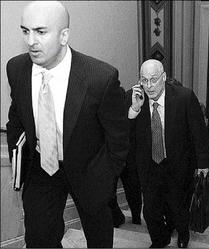
Treasury Department Assistant Secretary Neel Kashkari (top of stairs) and Treasury Secretary Henry Paulson. - File
Major stock markets around the world rose for the first time in days Monday as the United States said it plans to swiftly implement a broad financial rescue package and Europe put almost US$2 trillion on the line to break the lending logjam threatening the world's economy.
The Bush administration summoned executives from leading banks to a meeting in Washington Monday to work out details of the US$700-billion plan aimed at thawing the credit markets - the economy's lifeblood.
The package has quickly expan-ded from purchasing financial firms' bad debt to include the government taking partial ownership in banks, among other possible steps.
Stock markets around the world rose. The Dow Jones industrials gained more than 500 points in a rebound from days of staggering losses. European markets rallied following Asia's lead in response to the widespread government initiatives. And Latin American markets followed.
"These are tough times for our economies, yet we can be confident that we can work our way through these challenges and America will continue to work closely with the other nations to coordinate our response to this global financial crisis," President Bush said following a meeting with Italian Premier Silvio Berlusconi.
Face-to-face talks
On the weekend, Treasury Secretary Henry Paulson called the heads of the five biggest US banks to come to Washington for face-to-face talks about the rescue plan, according to people briefed on the matter.
They were not authorised to speak publicly because of the sensitivity of the negotiations.
Chief executives from Goldman Sachs, Morgan Stanley, Citigroup, JPMorgan Chase & Co and Bank of America Corp were all asked to attend.
The administration's interim bailout package chief, Neel Kashkari, said early Monday the government is moving quickly to implement the rescue programme, including consulting with private law firms on how to buy stakes in banks to boost their cash reserves.
Short-term funds
He spoke as the Bank of England, the European Central Bank and the Swiss National Bank jointly announced they would work together to provide unlimited short-term funds to make money available to ease the credit freeze.
The Bank of Japan said it was considering a similar move.
To assist the European banks, the Fed said it was taking actions to assure enough US dollar funds were available to meet demand.
"The government cannot just leave people on their own to be buffeted about," said British Prime Minister Gordon Brown.
Pledges by Britain, Germany, France, Spain, Austria and Portugal in recent days have reached a total of US$1.96 trillion. The sums are considered a maximum, and might not all be spent if the financial crisis eases.
The administration on Monday also announced the selection of a team of interim managers, picked an outside firm to help run the programme and tapped Federal Reserve Chairman Ben Bernanke to head up the oversight board guarding against conflicts of interest.
Kashkari, the assistant Treasury secretary who is interim head of the programme, said officials were developing the guidelines that will govern the purchase of bad assets and had consulted with six specialist law firms on how the government will take partial ownership of banks.
After those consultations, Kashkari said Treasury had chosen Simpson Thatcher & Bartlett LLP to move forward to help the government structure the stock purchase programme.
"We are moving quickly - but methodically - and I am confident we are building the foundation for a strong, decisive and effective programme," Kashkari said in a speech Monday to the Institute of International Bankers.
Kashkari, however, provided few details about how the programme will actually buy bad assets and partial ownership in banks.
Interim heads
He said five veteran government officials had been chosen as interim heads of key components of the programme including Tom Bloom, currently the chief financial officer at the Office of the Comptroller of the Currency, to serve as the chief financial officer for the rescue programme.
Kashkari announced that investment consultancy Ennis Knupp & Associates had been chosen as the private firm that will help Treasury review proposals from asset management companies. He said that 70 companies had made bids to become the master custodian firm and that a final selection of the winning firm would be announced by today.
He said more than 100 companies had submitted bids to become one of the five to 10 firms that will operate the programme to buy and manage the bad assets from financial firms.
- AP
Europe's pledge
A breakdown of the €1.9 trillion (USS$2.3 trillion) pledged by European governments to save banks:
GERMANY: Up to €400 billion (US$536.7 billion) in guarantees for banks, up to euro80 billion (US$107.3 billion) to recapitalise banks - allowing the state to take stakes - and euro20 billion (US$26.8 billion) to back up the guarantees.
FRANCE: Up to €360 billion (US$491 billion), including euro320 billion (US$436 billion) to guarantee bank refinancing and another euro40 billion (US$54 billion) for a government-backed agency to provide banks with extra capital.
SPAIN: Will guarantee up to euro100 billion (US$135 billion) in bank bond issuance this year after €30 billion (US$40.92 billion) promised last week for bank capitalisation.
AUSTRIA: Up to €85 billion (US$114 billion) in guarantees, and an additional €15 billion (US$20 billion) in capital.
NETHERLANDS: Will guarantee up to €200 billion (US$272 billion) in inter-bank loans, following €20 billion that it pledged for bank capitalisation last week.
ITALY: Finance Minister Giulio Tremonti said the Italian package would be worth "as much as necessary".
PORTUGAL: Announced Sunday it would guarantee €20 billion (US$27 billion) in inter-bank loans - nearly 12 per cent of annual economic output.
BRITAIN: Announced Oct 8 a £50 billion (US$88 billion) plan to partly nationalise major banks and promised to guarantee a further £250 billion (US$438 billion) of bank loans.
On Monday, government dipped into its 50-billion pound fund and said it would provide up to pound37 billion (US$63 billion) to boost balance sheets at three of Britain's largest banks.
SWEDEN: Government plans to put forward a draft law Wednesday to guarantee new bank debt until the end of 2009 and support banks with added share capital.
NORWAY: Outside the euro zone and the EU, Norway plans to offer new government bonds worth 350 billion kroner (US$55.4 billion) to banks to help improve liquidity in the market.