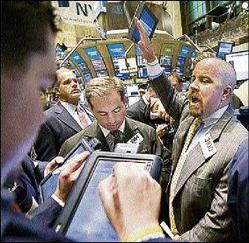
Specialist Daniel O'Donnell (right) works at his post on the floor of the New York Stock Exchange, Tuesday. Stocks staged a partial rebound early Tuesday after their biggest sell-off in years, though financial markets remained troubled a day after lawmakers rejected a $700 billion rescue plan for the financial sector. - AP photos
Stocks were volatile across the world on Tuesday, after United States lawmakers rejected a US$700 billion bank rescue plan late on Monday.
European stocks bounced up and down, Asian stocks fell, and the Dow Jones industrial average rose 1.76 per cent in early Tuesday trading in New York - regaining some of the massive fall the index suffered on Monday, when it plunged seven per cent, its biggest ever single-day drop.
Britain's benchmark stock index, the FTSE 100, fell by as much as three per cent in early London trading, with particularly sharp declines in the banking sector. But the index of 102 companies began recovering in the late morning, and was trading up 0.81 per cent at 4,858.01 by mid-afternoon.
Germany's benchmark DAX index fell by 0.84 per cent to 5,758.08, while the Paris CAC-40 was down 0.35 per cent at 3,939.55.
Stocks plunged
Russia's regulator, meanwhile, was forced to halt regular trading for two hours in its two major markets on Tuesday morning after stocks plunged in the opening minute of trading.
In Ireland, the volatility was massively upward, as the Government guaranteed all the deposits and borrowings - worth around 500 billion euros (US$717 billion) - of six of the country's major lenders. Ireland's ISEF Index of financial shares surged by as much as 25 per cent on the back of the guarantee, before settling to a rise of 20 per cent by the afternoon.
Some analysts were crediting Ireland's unprecedented move with helping to keep European stocks overall from falling nearly as much as stocks in the US and Asia did.
"The Irish government's blanket insurance could form a template for a European approach to this crisis," said Rob Carnell, London-based chief international economist at ING Financial Markets.
The high volatility was bad for credit markets, which became even more paralysed by some measures. The rate banks charge each other for overnight dollar loans, the London inter-bank offered rate, or LIBOR, soared to an all-time high of 6.875 per cent on Tuesday, indicating that banks are increasingly unwilling to lend to one another.
"The credit markets really need a US bailout deal to go through," said Richard Hunter, head of British equities at Hargreaves Lansdown Stockbrokers. "The alternative is unacceptable."
In Asia, most major stock markets fell Tuesday in stunned dismay over US lawmakers' rejection of the bailout plan.
Markets across Asia tumbled sharply as they opened amid fears that the setback could lead to a broader global financial crisis. But as trading progressed, many indices erased losses and Hong Kong's market staged a dramatic turnaround to close slightly higher as investors scooped up beaten-down shares.
Japan's benchmark Nikkei stock225 index slumped 4.12 per cent to close at 11,259.86 - the lowest level since June 9, 2005. In Australia, the S&P/ASX-200 index fell 4.3 per cent after falling as much as 5.3 per cent.
The bailout bill's failure dealt a "severe blow to Asia markets right after the Lehman shock," said Mitsushige Akino, fund manager at Ichiyoshi Investment Management in Tokyo, referring to the collapse earlier this month of the US investment bank.
"Many investors grew even more cautious because of the latest development over the bill, and they only see passage of the bill as a minor improvement to the crisis," he said.
Some markets bounced back. Hong Kong's Hang Seng index gained 0.76 per cent to close at 18,016.21 after earlier plunging more than 5.0 per cent.
Stunned
India's Sensex was up 2.4 per cent in afternoon trading.
Investors were stunned by the US House of Representatives' rejection Monday of a US$700 billion emergency bailout package that would have allowed the Government to buy bad mortgages and other sour assets held by troubled banks and other financial institutions.
With elections next month, many lawmakers were unwilling to take the political risk of supporting a measure that many American voters see as an undeserved bailout for rich, reckless investment bankers.
"This is a bad development," Australian Prime Minister Kevin Rudd told reporters in Australia's capital, Canberra.
He urged US lawmakers to urgently return to negotiations to come up with a deal that will prevent further infection of world markets.
Japanese Prime Minister Taro Aso urged the country's financial officials to closely monitor the situation and take appropriate measures to protect the world's No. 2 economy, according to Kyodo News agency.
"We have to respond appropriately in order not to affect the Japanese economy and to prevent the financial system from falling apart," Aso was quoted as saying.
Little exposure
Japan's banks have relatively little exposure to the bad mortgages at the core of the global credit crisis, but investors are worried that a slowdown in the US and global economy will hurt demand for exports.
The Bank of Japan on Tuesday morning pumped another three trillion yen (US$28.7 billion) into money markets, as part of efforts by central banks worldwide to boost liquidity and bolster inter-bank lending.
That brings the BOJ's total injection to 21 trillion yen (US$200.6 billion) since the collapse of Lehman Brothers Holdings Inc earlier this month.
The chaos sapped the dollar overnight. The greenback was trading at 104.32 yen Tuesday afternoon in Asia from above 106 yen a day earlier, adding further pressure on major exporters.
Markets in mainland China are closed this week for National Day celebrations, and Hong Kong will be closed Wednesday.
- AP