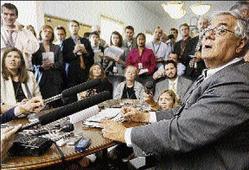
United States' House Financial Services Committee Chairman Barney Frank (right) speaks to reporters on Capitol Hill in Washington, yesterday. - AP
WASHINGTON (AP):
Democrat Barack Obama and Republican John McCain raised doubts about the Bush administration's US$700-billion bailout and demanded conditions that could snag its quick passage through the highly partisan Congress.
McCain, who only a week ago said the economy was fundamentally sound, now says the United States financial system is facing a major crisis. But he cautioned against giving too much power to Treasury Secretary Henry Paulson.
"Never before in the history of our nation has so much power and money been concentrated in the hands of one person. This arrangement makes me deeply uncomfortable," McCain told an Irish-American group in Pennsylvania, a key battleground state. "We will not solve a problem caused by poor oversight with a plan that has no oversight."
Oversight board
McCain praised Paulson and said he had spoken to him several times over the weekend. But the Republican candidate nonetheless called for a bipartisan oversight board for the proposed bailout, to be headed by Warren Buffet or another broadly respected business leader.
McCain also called on Congress to move quickly and work with the administration to restore stability to the troubled financial sector. But he said the goal of any action must be to allow homeowners to stay in their homes and prevent Wall Street executives from profiting from a taxpayer bailout.
Speaking on NBC television earlier Monday, McCain said, "We are in the most serious crisis since World War II."
He also said that despite the ballooning national debt, he would not raise taxes if elected president.
Obama ticked off seven conditions that he believed should be imposed on the Paulson proposal, joining some fellow congressional Democrats in raising warning flags and signalling the bailout mechanism might not make it out of the legislature by week's end as demanded by the Bush administration.
Obama said any bailout must include plans to recover the money, and protect working families and big financial institutions and be crafted to prevent such a crisis from happening again.


















