Mel Cooke, Gleaner Writer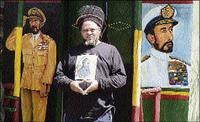
Fredlocks flanked by pictures of HIM Haile Selassie at Shashemene in Ethiopia.- Contributed
In 1975, midway the decade when Rastafarianism and reggae walked hand in hand from the dungles of Kingston and reclusive rural heights on to the world stage, a song of hoped-for reparation stamped itself permanently into popular culture.
It was not that there had not been back-to-Africa songs before or after, but Fredlocks' signature song articulated the vision simply and vividly, using the touchstone of Marcus Garvey's dream of a return to the Motherland - and, eventually, the source of charges against him.
The Black Starliner
In a distinctive high-pitched, lilting voice (not typical of the rest of Fredlocks' vast catalogue) the Harbour View, St Andrew, resident sang:
'Seven miles of Black Starliners coming in the harbour
I can see them coming
I caan see idrens running
I can hear the elders saying
These are the days for which we've been praying
It's repatriation
Black liberation
Yes the time has come
Black man you're going back home.
Marcus Garvey told us
Freedom is a must
He told us that the Black Starliners
Are coming one day for us.'
It took some time for Fredlocks' Black Starliner to leave the shipyard of his pen and sail into the ocean of recorded music. "Me write the song from '68," Fredlocks said. But he was quick to point out that it was far from a solo effort. "Is a man give me the idea. It come een like me co-write it," he said.
Rasta-inclined
"Me as a likkle yute now, cause a 40 year now me no trim, so 1968 me was 18 years old, 40 years ago. So me a get Rasta-inclined now, but true the norm was to sing love songs," the man who started out with the three-man group The Lyrics said. "So you have Bob Marley a come from in the '60s, everybody waan be Bob Marley an' from yu sing yu waan record for Studio One. So we have we group an' we a sing pure love songs. An' this elder Ras, bigger man for me by about two, three years sey (Fredlocks deepens his voice) 'like how yu a sight up de fait' now yu fe sing some cultural tune, sing some spiritual ting, y'nuh'."
The man, Owen Goode, did not give Fredlocks advice; he also left him with a line. It was enough, as Fredlocks says he is a good writer, having started from he was 12 years old and also being the writer in The Lyrics.
"So him say to me 'hear da ting ya!'," Fredlocks said, breaking out into high-pitched, fast-paced delivery of the first line. "An' him sey 'me a leave yu wid dat my yute."
yes, my yute
"Me neva so educated on Marcus Garvey, so me ask him where that come from an him say 'Marcus Garvey ting man, go read up Philosophy and Opinion of Marcus Garvey'. Two days time me come to him an' sey 'Owen, me finish write the song'. An' him sey 'yes, my yute'."
The writing was finished, but the recording was years in the making. Migration pulled The Lyrics apart and Fredlocks went the solo route, but Black Starliner was not on his mind.
But when a former lyric, Howard Roberts, came back home, it was revived on the playing field that is now the Harbour View Mini-Stadium. Roberts, who played guitar, asked Fredlocks if he had anything new and he sang Black Starliner. Roberts worked out the chords on his guitar, a cousin knocked a paint pan and, although they did not realise, someone was taping it all.
The open-air amateur engineer left and returned about an hour later with a Rastafarian named Hugh Boot, called Jah Shoes, who said he had never produced anyone before but he wanted to do so with the song he had just heard.
Even Fredlocks was impressed by the football field recording. "When him a play it back me a sey 'a so it soun' good'," Fredlocks said.
additional guitars
The studio recording was done at Randy's, North Parade, downtown Kingston, with Earl 'Chinna' Smith on guitars, Benbow on drums, Pablo Black on keyboard and Bagga Walker on bass, with additional guitars by Jah Jerry of the Skatalites and Howard Roberts.
Still, Black Starliner was not an immediate hit, as Jah Shoes tried to push it on his own. Eventually, they decided to work with Tommy Cowan, who had expressed an early interest in the song, and Black Starliner steamed majestically into reggae history.
After selling a mere 200 copies in the six months, 9,000 copies were sold in the three months after Cowan got involved. It hit the charts in Jamaica and went to number one in England, where it was named 'Star Single of the Year' for 1976.
haunted
But the original inspiration for Black Starliner, Owen Goode, haunted Fredlocks, even as he enjoyed the success that the hit tune brought, tours and all. "Da bredda, I no see him from I a yute," Fredlocks said, adding that Goode's brother died and it affected him badly. He left Harbour View. In 1994, when Fredlocks was in New York, he was introduced to a young singer who idolised him. The youngster had a surprise for him; it turned out to be Goode.
"Me sey 'Owen!' Me sey 'a me an him write Black Starliner!' Him sey 'I tell de man dem all de while an' dem never believe me'." It was not a long reunion, as Goode soon said "Me a go leave an circle me gates, don' leave till me come forward."
He left and although Fredlocks waited, he did not return. When someone checked his apartment some time later it was locked up.
"A one a de mos' mystic ting me see. An' is so him did mystic from him young, 'cause him jus' pass me an sey 'yu fe sing some cultural tune'," Fredlocks said.
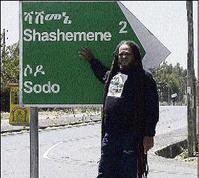
Fredlocks points to the road sign in Ethiopia which indicates Shasemene, where many Rastafarians live on land donated by Haile Selassie. 'Black Starliner' outlined the dream of returning to Africa in song.