Marcia Rowe, Gleaner Writer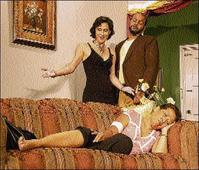
Jenni Campbell pointed out flaws in the script for 'Uptown Bangarang 2'. - Colin Hamilton/Freelance Photographer
This is the first of four articles on the state of Jamaican theatre. It is hoped that focusing the spotlight on this branch of the performing arts will initiate a discussion that will produce positive actions.
To change the character of any theatre, you must first of all change the basic assumption of the people who produce it.
Wycliffe Bennett
The history of transportation, slavery and colonisation has profoundly informed Jamaican theatre. In the 19th century, the once dominant European theatre, through social changes, was fused with the almost invisible African theatre. This blend resulted in the creation of an indigenous Jamaican theatre. And ever since its formation, indigenous Jamaican theatre continues to grow.
This growth is manifested in modern Jamaican theatre-goers having the options to see at least five plays per week between Wednesday and Sunday. They also have the opportunity to see two plays on some days, including an occasional avant garde play for free. But what is the true state of indigenous Jamaican theatre in the 21st century?
problems with script
To answer this question a number of areas must be addressed, the first being the scripts. The nucleous for any form of theatre is the play's script. Without a script there is no theatre. A script is the written document that cast and crew bring to life. It is often divided into acts and scenes. There are specific elements that theatre critics often use as guide when analysing a script. These include the growth of characters, the structure and the rising actions of the plot.
At this juncture, it should be pointed out that indigenous Jamaican theatre is classified into commercial theatre (traditional, pantomime and roots) and non-profit theatre. The non-profit theatre tends to go for serious scripts that present theatre as a catalyst for social or political change. But often a thin plot coated in light or low-brow comedy is the preference of the commercial theatre.
excellent work in JA
Undoubtedly, Jamaica has produced many playwrights who have written excellent works over the decades. But with the scripts being written by the producers of the commercial theatre, there is concern that some of these producer- playwrights have sacrificed quality scripts for profits. There is a tendency to create one-dimensional characters in most scripts, weak storylines and weak plots, among other flaws.
Eugene Williams, director of the School of Drama, Edna Manley College of the Visual and Performing Arts, explained that theatre as a lucrative business is the primary focus of commercial theatre everywhere. He further stated that this is especially the case for those in Jamaica who have opted to pursue it as full-time means of employment. Williams added that there are a lot of plaudits that the local commercial theatre deserves. But being motivated by the profit motive has not entirely negated discussion of social issues and quality.
Ancient Greek philosopher Aristotle, in his book titled Poetics, has stated that plays are imitation of life. And Jamaican scripts, throughout the decades, do mirror life. In essence, what is shown on the stage is a slice of life. But playwrights' selections of the slices of the Jamaican life that are presented lack discussion of social issues and quality. Their emphasis seems to be more on generating laughter than having any meaningful social discussions. Thus they write scripts with storylines that are classified as mundane.
some weaknesses
Jenni Campbell, in The Sunday Gleaner of May 4, 2008 highlighted two weaknesses in Basil Dawkins' Uptown Bangarang 2. Campbell noted that Dawkins is known to have written great scripts over the years, but he has fallen short. Campbell wrote that Uptown Bangarang 2 tells quite a mundane tale about a stereotypical pastor - (and that) Dawkins falls flat with weak characters".
Nadine Little, drama teacher of Four Paths Primary and Junior High School, believes the language of some plays is too vulgar and the messages are not uplifting for the younger generation. Playwrights must be conscious that their work is not only a mere imitation of life, but another form of documenting the history of a people in a specific time and specific period.
most scripts shallow
While acknowledging that there is growth in Jamaican theatre in general Kenny Salmon, head of Excelsior Community College's Department of the Performing Arts, noted that "most (scripts) tend to be shallow". He also believes that there are structural weaknesses, for example no rising action, so the story remains at one level, and plots do not develop. The plays do not build to a climax and end in an explosion. When this does not happen the plot has lost the ladder effect and instead ends with an implosion or an anticlimax.
Orville Hall's Below the Waist presents an example of a play-script ending in an anticlimax. Despite Hall's witty language, the required progression in the plot does not take place. This is particularly evident in the central plot of the story. Throughout most of the play Paul, the Rastaman, is being chased by the father of his girlfriend, Janice. Despite the heightened tension established in earlier scenes, the actions of the final scene peter out to an anticlimax when the father basically hands over Paul to his daughter; thus the plot implodes.
structural flaw
Another type of structural flaw is displayed in Patrick Brown's River Bottom. This is evident in Brown's use of flashback. The last scene in act one goes to a flashback; but instead of returning to the present, as in a previous scene, this flashback goes into intermission.
the main factor
Lenford Salmon, administrative director of Jambiz, explained that the script was in fact written accordingly but time was one of the main factors in their decision to edit out a part of the scene. This decision has continued to be worrisome and as such, despite the numerous performances which have already taken place, including the edited section of the script is still being considered.
But is the general theatre audience aware of the flaws in the scripts? The Jamaican theatre goers have the uncanny habit of enjoying predictable plots. To pre-empt the actors' actions reinforces the 'feel- good factor'. For such an audience the success of a play is based on how much they were able to laugh. "It is a good play; a laugh so till," is often their response. It is obvious that they do not recognise there are structural weaknesses and why they are able to pre-empt most lines, especially in the final acts of the plays.
But there are others who are very selective of the plays they view and they do so because they are aware that some scripts are flawed. For this group, how can the concerns raised be corrected?
Eugene Williams explained that what is needed for the enrichment of scripts and audiences is a vibrant non-profit theatre movement that is supported by funding instead of being entirely dependent on the box office. He mentioned that there are a few emerging theatre companies that are venturing into this type of work and providing another type of offering that is focused on provocative ideas and alternative ways of staging. Kenny Salmon believes conducting workshops, with seasoned playwrights and dramaturgists mentoring young and upcoming playwrights, as well as reviving old scripts, is a possible solution.
Next week the topic shifts to the state of the Jamaican theatre space.
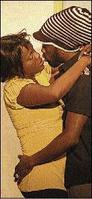
'Janice' (Deon Silvera) and 'Paul' (Orville Hall) get close in the comedy 'Below the Waist'. The play has an anticlimactic ending.- File