Robin Lim Lumsden, Contributor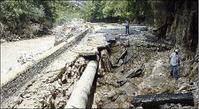
The Bog Walk gorge after it was severely damaged by Tropical Storm Gustav. - Norman Grindley/Acting Photography Editor
Hurricanes are horrible and humbling things. They cause us to feel vulnerable, to stop what we are doing and genuflect to a greater force or God, to appreciate the meaning of the Serenity Prayer's "things beyond our control", and to become all too familiar with the grace of patience. The fact that we are in God's hands is a comforting thought, along with the realisation that our current daily obsessions and grievances may merely be storms in teacups.
Adversity brings out the resilience of the human and community spirit - exemplified by the policeman and policewoman I met from Gordon Town, who, without even the proper rain attire, were walking from village to village to check on the residents after the storm. The destruction wreaked by Gustav, Hannah and Ike throughout the Caribbean, and the inconvenience and danger caused to all who live in rural areas, makes us see clearly the need for long-term solutions to global trends.
Hurricanes allow us all to experience what life is like without the basic amenities of running water, electricity and telephone communication. It is extremely depressing, oppressive and mentally exhausting when the slightest chore, such as staying clean, becomes a strenuous task. Hurricanes, therefore, provide us with an important reminder of a simple truth: as a nation, we have to commit ourselves urgently to making these basic, decent, living standards universally available to all in our country.
There are huge problems facing us both as a nation and as a world. The fact is, however, that, while many things are beyond our control, there are things within our control that should be addressed by our government, to ameliorate the inevitable human suffering.
identifiable trends
There are a few identifiable global trends, such as the increasing severity of weather systems, which, whether due to global warming or not, pose a significant threat to our island. Another is the increased price of oil and the rising cost of energy. Also documented is increased population pressure, causing massive soil erosion due to unsound environmental practices, the destruction of the world's forests and the resultant need to protect infrastructure and public utilities, such as roads and water supply. These three trends are all interrelated and unfortunately, they are here to stay. In view of this, I believe it makes sense to come up with some practical, long-term solutions that promote self-sufficiency at every level of our society.
An honest, bipartisan, national discussion about the dangers of squatting and opportunities for alternative, affordable housing solutions is urgently needed. Food for the Poor's housing project may provide us with some direction. In addition, there are vast acres of flat land, beside the highway going towards Spanish Town, that are not under cultivation. This land perhaps could be looked at for developing lower income housing.
There should be a comprehensive review of all Jamaica's major road arteries and a plan to preserve them; they are national assets. Simultaneously, there should be an immediate review of all projects under development, which are now causing road damage and costing the government millions in road repairs. Heavy fines should be imposed on those projects causing environmental destruction.
Along with this, stricter and more serious enforcement of building codes needs to be implemented.
A bipartisan review of the National Environmental Planning Agency's (NEPA) effectiveness should be urgently undertaken. We cannot afford such an important, regulatory agency, whose mandate it is to protect our environment, to be stymied by lack of funding, political influence or bureaucratic inefficiency.
comprehensive review overdue
A comprehensive review of Jamaica's water supply is way overdue. The Mona Dam was built in the 1950s and it is said that half of the pumped water is lost to leaks. We need an open discussion on what the Government proposes to do to address this inadequate and outdated system and what it would cost taxpayers to improve it and increase its capacity. For now, to provide an incentive, remove all taxation on water tanks and water pumps and put in place requirements for builders of new schemes, to build water catchments, gutter systems and cisterns under their houses. This was done in the old days and we do not have to reinvent the wheel to solve all of today's problems.
The developed world is making plans to reduce its dependency on oil through investment in clean, alternative-energy sources. It is high time Jamaica get on board. This can be done by setting the price of electricity sold by independent producers of energy to the JPS' grid for the next 20 years to give investors a good and reliable return on their investment to encourage investment in alternative forms of energy, such as solar and wind. This approach has been adopted and proved effective in Germany, where it is increasing the percentage contribution of solar energy to the total national-energy pool. Last, improve the tax incentives to go solar and in tandem, ban the importation of cars which do not meet modern fuel-efficiency standards.
Natural disasters unveil man's ingenuity, short-sightedness and stupidity. They also lay bare the insidious cost of corruption. Landslides on rural roads can largely be attributed to blocked culverts, dumping and illegal building practices. It is always easy to blame the poor and disenfranchised, but often, much of the destruction is caused by the 'big men', who are able to get around building regulations. The Kingston and St Andrew Corporation, National Works Agency (NWA) and NEPA must clean up their act and play the important role of protecting the public interest, rather than using taxpayers' money to clean up the mess after the fact.
The ingenuity of the operators of the front-end loaders and backhoes, who worked tirelessly to dig out the residents along the Irish Town Road of St Andrew within 24 hours of the storm's hitting, was truly amazing. Commendations to the phone companies who kept working throughout and to JPS, who had the power back within 48 hours.
We are now almost two weeks post-Gustav and running water has just been restored. The NWC's modus operandi of replacing the plastic water pipes, which break after every storm, is not a sustainable, long-term solution. Increased storage is needed.
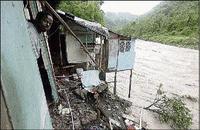
Omar Newman looks on at what is left of the house in which he lived in Broadgate, St Mary. At least four houses were washed away by the Wag Water River after the passage of Tropical Storm Gustav. - Ricardo Makyn/Staff Photograppher
rebuilding
The road along the Hope River, which connects the city of Kingston to Gordon Town and Newcastle, is under threat, as is the main water supply to the Mona Reservoir, again due to irresponsible development and poor planning. A small and inadequate culvert was built after Hurricane Dean. It seems ludicrous that such an important road did not receive some more careful thought and attention. The Newcastle road is also impassable over to Portland and many coffee farmers in this region are cut off. Again, there seems to have been a lack of prioritisation in the rebuilding of the breakaways after hurricanes Dean and Ivan in order to preserve that road.
Harnessing our "vision lest we perish" is particularly germane to Jamaica right now. Making the correct, long-term bets on our future, while managing the challenges of the present, is what we elect a leader for. Not everyone is cut out for the job. In my opinion, Mr Golding seems rather bogged down by the many problems facing his government, many of which, he could argue, he inherited. While the People's National Party is embroiled in a heated leadership battle and the Jamaica Labour Party seems to be suffering from crisis fatigue and myopia, Jamaica needs a survival plan.
The Government cannot be expected to solve all our problems; citizens and their communities have to be partners in finding the solutions. Jamaica has proven we can unleash ingenuity, but we need the wisdom to leave behind the partisan short-sightedness of the past. This is an urgent appeal for some strategic, practical thinking and long-term planning.
Feedback may be sent to Robin Lim Lumsden at limlums@cwjamaica.com or columns@gleanerjm.com.