Mario James, Gleaner Writer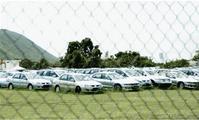
Meagre auto sales have resulted in stockpiling of the slow-selling product, as depicted at this in-bond warehouse. Government has introduced duty reforms that some dealers hope will turn the trickle of sales into a stream. - File
WITH THE failure of alternative investment schemes, almost predictably, the new-car market has softened. Sales have slackened off almost 50 per cent in some cases, with only government contracts keeping some dealerships afloat.
"The current business climate has affected a lot of us [dealers]," said Paul Issa, deputy chairman, Issa Transport Group. "We have seen a drop in sales over recent months. This is due to a number of factors, but one significant factor is the recent legislation drafted on concessions that travelling officers in the civil service are eligible for."
Even Toyota Jamaica (ToyoJam), with its traditional stranglehold on the Jamaican market, has been feeling the pinch.
Howard Foster, sales and marketing manger for ToyoJam, indicated that deposits are down. He, however, said that his company wasn't exactly reeling from the body blows being rained on the sector by the economic climate, as Toyota was still moving more than 100 units per month.
Toyota also offers transport solutions in other markets, such as their Coaster and Hiace, pillars of sales that a lot of other car companies have not got during the lean times.
Trying period
Meanwhile, president of the Automobile Dealer Association, Kent Lacroix, has said that the last three months have been exceptionally trying for some dealers.
"The current state of affairs has brought a mixed bag, as the recently implemented tax regime has been kinder to some dealers than others. This has been compounded by the failure of the alternative investment schemes. Historically, some dealers have been able to stock based on past trends, and the market suddenly drying up has caught some of them out. One thing is for sure, we are not going to see large amounts of inventory as commonplace as we see today, as it no longer makes good business sense in today's volatile economy to have huge stockpiles of product," he told Automotives.
Speaking to Finance Minister Audley Shaw on Friday, Automotives learnt that under the system that existed before April this year, vehicles had no cap on the engine size that civil servants were allowed to bring in.
That regime was revised in April, which saw a cap being introduced on both the cc rating on and its cost, insured and freighted (CIF) value. The CIF had a ceiling of US$25,000 and the cc rating was capped at 2500 cc for both diesel and gas-engined vehicles.
Revision
On Thursday, a press release was issued by the Ministry of Finance which stated: "After review and careful consideration to requests made by public sector bodies, the previously announced engine size maximum of 2500 cc will be moved from 2500 cc to 3000 cc for petrol vehicles, and for diesel vehicles, the maximum will be moved from 2500 cc to 3200 cc. The CIF value of a maximum of US$25,000 remains, above which full duty will apply."
This would mean that for a vehicle costing US$30,000, only US$5,000 would attract duty if its power qualified for the concessionary rate.
Issa welcomed the new move as a step in the right direction.
He intimated that it would go a long way in stimulating the flagging sales now being experienced by new and used car dealers.
He said, "I hope the ministry will institute these new measures as quickly as possible to avoid the lag that will occur while prospective customers wait for the new measures to take hold."
The new concession rules are slated to take effect October 1.
Send feedback to mario.james @gleanerjm.com or columns@gleanerjm.com.


















