Grow them now - Part III
published:
Thursday | September 4, 2008
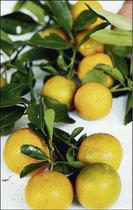
Left: Kumquat: An oval-shaped citrus fruit with an edible skin; it is difficult to peel so just rub it in your hands and eat it all. It has a bitter-sweet taste and is used in marmalades or as a garninsh for sweet and savoury dishes. The miniature tree is grown in Jamaica primarily as a decorative plant so that gives you an idea of where it can be grown.
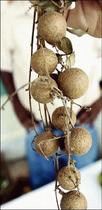
Right: Longan: Looks like lychee in size and birds love this sporadic bearing fruit. It can produce more abundant crops than lychee and the tree takes four years from planting to start producing fruit. Best in cooler parishes. - photos by Ricardo Makyn/Staff Photographer
Lip service
I saw your two articles on Thursday August 28 on fruit trees and I agree with you. I have been living in Mandeville since 2000 and since I came here one Mr Reg Burgess had this miracle fruit tree plant.
I have been trying to lease some lands from the bauxite company for more than three years now. Windalco told me that they have lands but they are not ready to lease as yet. Some months ago I saw the minister of agriculture and spoke to him about helping me to obtain some lands for leasing from the bauxite company. He told me to write to him which I did. I got no reply.
I am getting nowhere with this land deal. My experience is that there is not that much interest in farming, it's only lip service. So when Trinidad is exporting jerk sauce to Jamaica, I am not surprised.
We need consistency in our production. I need 100 acres to plant fruit trees so that I can look at the export side of business.
lue_oval@hotmail.com
So Right
You are so right, but now that yams will be celebrated in the foreign countries and eaten by their peoples, then I suppose it would be okay to serve them in different exotic styles and presentation on our tables on weekends.
Online reader, Boston, Massachusetts
Billion Tree Campaign
We were pleased to learn of the Rural Agricultural Development Agency's (RADA) initiative to grow fruit trees from an article Let's Grow them now: Part II published online on August 28.
We would like to invite RADA to join the "Plant for the Planet: Billion Tree Campaign"
The 'Plant for the Planet: Billion Tree Campaign' is a unique world-wide tree planting initiative spearheaded by the United Nations Environment Programme (UNEP). It was unveiled in November 2006 as one of the responses to the threat of global warming, as well as to the wider sustainability challenges from water supplies to biodiversity loss.
The campaign is aimed at empowering individuals, communities, business and industry, non-governmental organisations, civil society and governments to take simple, positive steps to protect our climate.
Tree planting pledge
Under the Billion Tree Campaign, participants enter tree planting pledges on-line at www.unep.org/billiontreecampaign and once the trees have been planted, they are required to revisit the website and register the number of planted trees.
The campaign has become a practical expression of private and public concern over global warming. To date, the campaign's website registers 2.2 billion planted trees and 3.8 billion tree planting pledges from across the world with participants coming from all spheres of society; from the grassroots level to the highest positions in decision-making.
Due to its success, and by popular demand, UNEP decided, in May to raise the objective to seven billion trees, one tree per person on the planet, by the crucial climate change meeting in Copenhagen, Denmark in late 2009.
For more information on the Billion Tree Campaign, please visit: www.unep.org/billiontreecampaign
We look forward to hearing from you.
Kind regards,
Leah Wanambwa
Consultant - Billion Tree Campaign
Division of Communications and Public Information (DCPI)
United Nations Environment Programme (UNEP)
PO Box 30552
Nairobi 00100
Kenya
Tel: +254-20 762 3018
Fax: +254-20-762 3692
web: http://www.unep.org/billiontreecampaign.
We continue our series of tropical fruit trees showcased at this year's Denbigh Agricultural Show with a look at longan and kumquat. Food turns the spotlight on responses from readers and thanks the public for the interest shown in the series. We extend our sympathies to the farmers of St Mary and Portland in particular and the rest of the island who lost crops. We know you will bounce back as we continue the drive to grow what we eat so we can eat what we grow.
Perhaps the time has come to consider investing in some mega food storage facilities so that surplus can be stored at the right temperature for the months of shortage following tropical storms and hurricanes.
For information on how and where to obtain the fruit trees, contact RADA at:
Hope Gardens, Kingston 6 or telephone:977-1156 or Lockley Waites at;468-9066 or Dennis Brown at: 577-9575.