AP
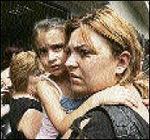
A woman holding a child stands outside the Civil Registration Center in Tbilisi, Georgia, yesterday. Hundreds of internally displaced Georgians wait outside the Civil Registration Center to register their arrival in Tbilisi. Tens of thousands of refugees arrived in Tbilisi to gain official refugee status and qualify for free food and lodging.
TBILISI, Georgia (AP):
Georgia's president grudgingly signed a truce with Russia on Friday, even as he denounced the Russians as invading barbarians and accused the West of all but encouraging them to overrun his country. Standing alongside, a stone-faced US Secretary of State Condoleezza Rice said Russian troops must withdraw immediately from their smaller neighbour.
United States President Georgia W. Bush talked tough, too, accusing the Russians of "bullying and intimidation", but neither he nor Rice said what the US might do if Russia ignored them.
Russian President Dmitry Medvedev's press office had no information Friday night on whether he had signed the cease-fire agreement. And as Rice spoke in Tbilisi, Russian forces remained camped out just 25 miles (40 kilometres) away.
Associated Press reporters had seen a convoy of some 50 Russian army trucks and armoured personnel carriers roar without warning southeast from the city of Gori on Wednesday, some shouting they were heading to Tbilisi. But they veered into a field outside the town of Igoeti and set up camp conspicuously within sight of the road. The Russians were still visible there Friday.
Show of solidarity
Even as Rice stood with Georgian President Mikhail Saakashvili in a show of solidarity, he asked, "Who invited the trouble here? Who invited this arrogance here? Who invited these innocent deaths here?"
Shaky and near tears following a difficult, nearly five-hour meeting with her, Saakashvili answered his own question: "Not only those people who perpetrate them are responsible, but also those people who failed to stop it."
Rice let that pass, focusing instead on the demand that Moscow immediately withdraw its forces.
"With this signature by Georgia, this must take place and take place now," she declared.
There was no immediate clue to the Russians' intentions a week after their tanks and bombers attacked Georgia in retaliation for Georgia's attempt to retake a disputed province by force.
Russian troops allowed some humanitarian supplies into the strategic city of Gori but otherwise continued their blockade.
Saakashvili said on CNN, "Russia has widened its zone of occupation and so far we are waiting for it to comply with the agreement."
International peacekeeping
He did not elaborate on where Russian troops were. He urged Medvedev to sign the truce, and appealed for a quick international peacekeeping force for his country. "I cannot do much to protect my own people," he said.
The cease-fire document sets out no specific penalties or deadlines. It contains concessions to Russia that Saakashvili obviously found hard to swallow. Russia could retain peacekeeping forces in the separatist region of South Ossetia and another breakaway region, Abkhazia, and the forces would have a broader mandate in South Ossetia.
French President Nicolas Sarkozy's office said Friday in a statement that Medvedev confirmed he would sign the accord and assured the French leader that "Russia would scrupulously respect its commitments on this agreement, notably confirming the withdrawal of Russian forces".
The Kremlin said in a statement that Russia would sign the deal "as a mediator." That is an apparent reference to United Nations Security Council resolutions that define Russia as a "facilitator" in the dispute between Georgia and its nominally sovereign breakaway regions.
Even if Russia fully complies with the cease-fire, the Bush administration says there will be more consequences to come. Bush's advisers are settling on penalties that would be intentionally modest and subtle, such as continuing to exclude Russia's foreign minister from discussions among his counterparts in elite gatherings of the world's leading economies.
The idea is to give Moscow the diplomatic cold shoulder while offering face-saving leeway for Russia to turn away from a mentality the West sees as throwback to its empire days. Russia would then have motivation, and some wiggle room, to seek inclusion in Western economic, political and security institutions.
Thuggery
In Washington, Bush accused Russia of resorting to thuggery from another era. He insisted the United States will not abandon Georgia, a Western-leaning democracy on Russia's southern flank and once part of the old Soviet Union.
"Bullying and intimidation are not acceptable ways to conduct foreign policy in the 21st century," Bush said. "Only Russia can decide whether it will now put itself back on the path of responsible nations or continue to pursue a policy that promises only confrontation and isolation."
The peace pact was worked out earlier in the week by French president Nicolas Sarkozy and both sides had said they agreed to it.
Russian forces remained, however, and US officials said the document would take effect once it was formally signed Friday. It tells both sides to pull their forces back to the positions they held before fighting broke out last week in South Ossetia.