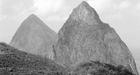
The Pitons in St Lucia.
Title: St Lucia Portrait of an Island - Collection of photographs
Author: Jenny Palmer
Publisher: Macmillan Caribbean
Reviewer: Paul H. Williams
The peoples of the Caribbean islands are alike in many ways, and we have a similar culture and history. The geographic landscapes of the region, though miles apart, in many respects are not much different either, and so a trip to any of the islands is like déjà vu, despite variations here and there. Yet, each has its own brand, its special magic, something that makes it stand out from the rest. In Portrait of an Island, Jenny Palmer, through a series of photographs, has presented to the world the charm and mystique of St Lucia.
Between hard covers, wrapped with a silky-smooth jacket, are 193 pages of photographs showing the beauty of the land and people, and the richness of its culture, plus a preface from the photographer herself, an introduction by St Lucia-born poet John Robert Lee, and quotations from Derek Walcott, Nobel Literature Prize laureate and native of St Lucia.
Lee's introduction is quite informative and enlightening, giving a brief history of the volcanic island that is only 27 miles long by 14 miles wide. Its heritage is rich, underscored by the fact that this small, idyllic place was once the object of a tug-o-war between Britain and France. Hence, though regarded as an English-speaking country, "most St Lucian speak patwa (patois), a syncretic blend of African, French and English elements."
Every October, St Lucians celebrate Jounen Kwéyol (Creole Day), "on which only patois is spoken and Creole food and music, along with our national dress, are the distinctive order of the day," says Lee. Can you imagine such a day in Jamaica? Patois Day? He says further, "Patois was once a despised tongue, forbidden even by uneducated parents to their school-going young ... Parliamentarians now address the public in Creole, something unheard of in the past." Sounds familiar anyone? One Caribbean, one people.
The faces of some of these people are captured by Palmer in their diversity, the children especially. They tell the story of St Lucia's racial composition.
The quaint board houses are reminiscent of those you see in the Jamaican countryside. On page 31, the scene of a house framed by two lines of clothes and banana trees is all too familiar.
The enchanting landscape is frozen in time by Palmer's pictures, which transport you around the entire island. Not surprisingly, photos of the signature twin peaks, Gros Piton and Petit Piton dominate. They were taken from many angles, ranges and elevation. On page 88, where they appear to be touching, is the most creative for me; quite an illusion it is.
Like the Pitons, the sea around St Lucia is well featured from various perspectives. The seascapes are breathtaking, and you get the feeling that you want to jump into the turquoise-looking water of Marigot Bay, shown on page 34. Shot from above, the panoramic view is simply fantastic.
The most dramatic picture is that of an egret landing into a tree. It's a rare sight so close up, and Palmer was able to catch the elegant white bird, with wings raised high, against a dark-blue sky. Haunting is the image of Derek Walcott under the silhouette of a tree with a low-gloss sea shimmering through the branches.
An exciting array of photographs is what this book has. Whether it's the historical buildings and sites, the food, flowers, children at play, the villages in the distance, women selling, the sulphur springs, the old board shop in Anse la Raye, it is an excellent collection by someone who seems to have more than a professional interest in the Caribbean.
Palmer's biographical notes say she divides her time between London and the Caribbean with her children. She has a first-class honours degree in visual arts, specialising in photography, and this, the second edition of the book, eloquently says she is deserving of such high honours. Visit her at www.sparklesportrait.com to learn more about her work. St Lucia Portrait of an Island should be a refreshing addition to your coffee-table books, all 208 pages of it.


















