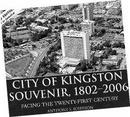
AUTHOR: Tony Johnson
TITLE : City of Kingston Souvenir, 1802-2006
Politician and historian Anthony Johnson in 1993 produced his first of three books that focus on the city of Kingston (Portrait of a City). His second of like character appeared in 2002 (City of Kingston Souvenir). His third was produced in 2006 (City of Kingston Souvenir, 1802-2006: Facing the Twenty-First Century).
But judging by the fact that the cover of the edition that has recently come to hand has a corner strip that reads 'Second Edition' is a bit puzzling and is not explained in the text.
In this 2006 edition, the author states in the preface that the book is intended to aid understanding in the "decline, growth and expansion of various sections of Kingston."
He selects three perspectives to highlight: business and residential districts, the impact of sports, particularly the game of cricket on national life, and the entertainment industry.
In pursuing those objectives he evidently sees his work as building on the other editions that focus on Kingston. In this one, he indicates an analytic approach that will make him explore trends and developments. The assumption is that by this approach he will enable readers to better make assessments of the city today and tomorrow. This analytic, even prescriptive approach is mixed nevertheless with his descriptive records of the city's rich historical origins and significant turning points for better or worse.
Critical observations
His approach is laudable even if consequential, for each of those objectives could easily be a book in itself. Logically then, critical observations may be made as to what to include or exclude. Therefore, caution has to be exercised that the author is not critiqued unfairly as to his selections. Surely, given the cost of printing for such a much more limited audience than the writer of say, a romantic novel would have, the author did a reasonably good job, even if some glaring omissions might be identified for those who have the benefit of hindsight.
Two pragmatic steps by the author and publisher ought to be noted. One is that the printing is done in China where the cost would be much lower. The second is that 20 pages of advertisements help to defray expenses. Normatively, for this type of table-top prestigious publication, ads are frowned upon. But increasingly, that understanding is being 'winked at' as printing costs rise. Countries of small populations do have a big problem seeking to put out such prestigious publications. For example, in the Cayman Islands, the Government there met an enormous bill for getting published a history of that country.
Business establishments
In this book, the inclusion of the advertisers may be considered more integral than may be normally assumed for the ads help to portray the kind of business establishments in the city. Furthermore, the quality of the ads is commendable. Some of them reflect high standards in creativity, conformity to the character of the publication, and use of colour.
On the whole, and going to the text in particular, the subtitle indicates a distinctive style for this third edition, making that an analytic and futuristic look: Facing the 21st Century. The second major section of the book is taken up with this concern for the future, in process, before prognosticating, abstracting trends from the past and focusing on issues currently prevailing. The three articles that dominate this thinking in the second section are brilliant in analysis and disappointing only in the fact that the sensible practical recommendations have been mostly ignored, which cannot be counted against the author.
The first of these analytic and predictive contributions, mentioned in order as they appear, is by Brooke Riley, architect and town planner. His contribution is entitled: The Planning Problems of Downtown Kingston, (Jamaica Architect, Vol. I, No. 3 1967/68). The second is by Dr Ivan Goodbody, pofessor of zoology, University of the West Indies: The Impact of Development on Kingston Harbour (Jamaica Architect, Volume II No 1, 1968). The third is by R. A. Brandon: Can the Gullies of Kingston be Recreation Parks? Jamaica Architect, Volume II, No.1, 1968).
Fears and failings
Interestingly, these three scholarly predictive articles are all taken from publications that appeared approximately 40 years ago. Furthermore, the indications of fears and failings expressed then have more or less been substantiated. At least, photos would have enhanced these presentations, especially so in a book dominated by photos over text.
Otherwise, the use of many colour photos enhances this book and makes it attractive at first glance. It is a beautiful table-top production. Therefore, by genre and quality, this book is suitable as an 'exhibition' piece in the offices of political and professional persons, diplomats, hotels, etc.
For the good printing quality, the credit must go to China. The quality of photo-reproduction is excellent and so is the binding and page alignment. Where standards fell short was in the photo editing. This is clearly evident when photos are grouped and head sizes compared or keen observation made regarding space allowed over heads, in regard to consistency.
Also, photos without captions (p. 3) and photos of groups, especially photos of modern (pp.71-78) staff of the Kingston and St Andrew Corporation (KSAC) disappoint. Regrettably, there is no name identification of two historic cricket teams, taken a century apart, by which time the white cricketers were replaced entirely with blacks (pp. 142-143). Caption errors are numerous, and are corrected on a slip artfully and helpfully attached subsequent to the printing.
The prime minister and the leader of the opposition then, have excellent photos but, regrettably, the photos of the governor general and the mayor of the city fall terribly short in regard to clarity of the eyes and comparatively to size of heads.
Significantly lacking is a photo of Marcus Garvey. Also, Bob Marley, especially when Jamaican music is introduced. Also, cricket great George Headley deserves more than an action shot compared to the large profiles of other outstanding Jamaican cricketers, such as George Mudie of Kensington, or, a swimmer such as our great Barrington Roper. Under Entertainment, surely, Louise Bennett and Ranny Williams as well as Charles Hyatt deserve photos.
Outstanding feature
An outstanding feature of the photography on the whole is the aerial shots. They are superb and some of them masterpieces, especially those of Trevor Riley. The shots of statues were disappointing (p. 17). However, author Tony Johnson doubling as photographer did a very good job in some instances, such as those of King's House (p. 18) and Devon House (19), but did not do justice to Coke Memorial Hall (214). Also excellent are the Jamaica Information Service shots of Emancipation Park (p. 36) and track athletics heroes Asafa Powell and Merlene Ottey (p. 120).
Some photographs lack quality but must be commended for being researched and obtained at all, such as those of Bishop Mary Coore (p. 222), Rt Rev Monsignor Wilson (p. 223), Ernest Ranglin (p. 129), Alexander Bedward (p. 30), Charles Lindberg (p. 31), J.K. Holt, Sr, and Reggie Matcham (p. 145), and George Liele (p. 219). Perhaps similar research effort would have been rewarded readers with a photo of St William Grant in whose name the principal city park stands as a memorial.
Enhancement
The last 40 pages of the book are devoted to ads, which enhance the work, not merely because of needed funding, but because they may be perceived as an extension of the closing chapter on 'Business in the City'. However, the standard of the photos of the business leaders was inconsistent and the layout too spaced.
Significantly lacking was a full-page colour map of Jamaica as well as of the wider Caribbean, which would place the city of Kingston contextually, at least in terms of geography. Also, perhaps it is not too much to suggest that photos could have been included of slums and market vendors, to bring greater reality to the presentation.
Despite shortcomings, this is a refreshing 'oasis' for readers about the city of Kingston, especially to visitors and as well for researchers and librarians. Gems of information are to be found and the constructive chronicling of significant events as well as interesting discussions about the city's structure and future are enlightening and useful.
This volume is well worth reading and referencing. Indeed, it is a good companion to the authoritative and definitive work of Olive Senior's A-Z OF Jamaican Heritage.


















