Avia Collinder, Sunday Gleaner Writer
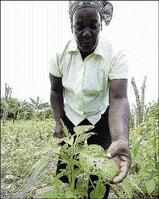
White fly infestation has destroyed this crop of callaloo on Joan Buchanan's farm. - Ricardo Makyn/Staff Photographer
CLIMATE CHANGE is one term with which the smallest of small farmers in St Thomas should now be familiar. Joan Buchanan, a 53-year-old farming veteran, knows this as intimately as she knows when her bananas are market ready.
Buchanan remembers the years when she could set her pot on the fire from predictable earnings of her work and send her children to school dressed in 'good clothes' too.
But, in recent years, with hurricanes producing frequent rains, floods and blistering heat, farming is a gamble worse than buying the games that people play, Buchanan says.
When The Sunday Gleaner - in late July - visited her farm, located on a few acres outside of Seaforth, the callaloo was spotted with white fly disease as was the gungo, which otherwise would provide a sure income for the Christmas season.
heat and rain
She laments the heat that sucks life from her hungry plants and the periodic rain which floods her plot.
"The other day, I planted tomato and sweet pepper and I lost both - between the rain and the sun. The last rain blighted the cucumber," Buchanan recounts.
With no irrigation on her farm, the only plant she can afford to water when the dry time comes is the callaloo.
Nkrumah Green, technical adviser attached to the Women's Resource and Outreach Centre (WROC), which provides small farmers in 11 St Thomas communities with material and technical assistance, says that climate change and the loss of tree cover makes farming a worse gamble than it ever was.
Climate change brought on largely by global warming, results in increased incidence of hurricanes, floods and other natural disasters. Usually, periodic flooding alternates with the onset of drought.
Along with hurricanes that come more frequently, small farmers themselves are also part of the sad tale of this change.
Having no system of irrigation and desperate for cooler lands for planting, residents strip the hillsides of trees. When it rains, top soil is tripped from the unprotected lands, blocks the drainage systems and flooding occurs downstream.
Buchanan's land is periodically flooded, washing away her expectations with them. This year, she had more hope than usual, having received a small loan from WROC to pay a male labourer to assist with crop production.
In good times, her land yields sweet pepper, okra, callaloo, and tomatoes, which are kitchen-table perfect. But, the heat and periodic flooding this year are costing her too much.
"I was expecting to reap a crop (callaloo) next weekend," she bemoans. "But now, it is bored (full of holes) and nobody wants it like that."
Buchanan recalls too that both hurricanes Ivan and Dean meant starting everything over again. Now that the callaloo crop is devastated by disease, she will have to plant again.
Her biggest problem, Buchanan says, is that the land is not owned by her - most of it is leased. If she owned the land, she reasons, "I would plant tree crops like soursop, ackee, coffee, so later when I can't labour anymore, I could help myself".
With her land title, she would also be able to get the loans to install irrigation and make other seasonal inputs which are needed. But this also, for now, is another pipe dream.
WROC aid
Instead, she depends on organisations like WROC, which cover the costs of back-breaking labour. Admitting that none of her three children is interested in farming, she explains: "Farming is a rough calling. You plant the crops and it's a gamble."
Buchanan still has high hopes this year for the gungo and several thousand pounds of sorrel she has also planted. That is, if no hurricane or flood should come this year to drown the plants and her expectations along with them.
She despairs of getting help from government agencies, although the voices about food security are loud.
"If you are not deep into the politics, if you don't mix up in it big time and have a godmother or a godfather, there is no help for you," Buchanan comments.